AWS: Certified Cloud Practitioner


Some last notes I took before taking and passing the AWS Certified Cloud Practitioner Exam (February 22, 2022).
Key areas I wanted to focus on and understand better.
Databases
- DynamoDB - Unstructured NoSQL, auto-scales
- Aurora - Cloud-first MySQL and Postgres replacement, self-healing, Aurora is more performant, durable, scalable, resilient than RDS
- Redshift - data warehouse
- RDS - Managed DB, more DB’s supported than Aurora (Oracle)
AWS Billing and Cost Management Tools
By order of information:
- AWS Cost Explorer - query resource cost via API, visual UI, the highest level of granularity
- AWS Cost Reports - generates S3 reports
- AWS Budget - predict spending, optimize use, some forecasting
- AWS data migration tools
By order of max data to transfer:
- Snowcone - GB to TB
- Snowball Edge
- Snowmobile - TB to PB
AWS IAM distinctions
- Policy - an object that defines an identity’s permissions
- Role - groupings of policy that facilitates a specific set of responsibilities
- User
- Group
AWS Gateway differences
- API - Allows access to API endpoints, methods
- Internet - VPC to public internet, bidirectional
- NAT - resources in VPC to public internet, unidirectional
- File, Storage - optimizes multipart uploads and bandwidth for file uploading
AWS Identity Management services
- Cognito vs AWS SSO - Access to Apps, Services vs. Access Across AWS Accounts
Note that AWS SSO has been deprecated and replaced with AWS IAM Identity Center.
Different AWS security services
- AWS Inspector - Finds and identifies security vulnerabilities and security best practices, EC2
- AWS Trusted Advisor - AWS best practices (general), an AWS Support service
- AWS Security Hub - Integrates with Trusted Advisor, finds and recommends improvements to security practices
- AWS GuardDuty - Threat analysis on logs
App/Resource security:
- AWS Shield - DDOS
- AWS WAF - web app exploits
- AWS Network Firewall - inbound, outbound rules
Keys/licenses:
- Secrets Manager - App secrets, DB credentials
- KMS, CloudHMS - generates and signs cryptographic keys - ERC20, SSL, Web Server identity verification
- Artifact - Compliance
- IAM - Permissions
- Certificate Manager - TLS
AWS network security differences
- Network ACL - applies to VPC
- Network Security - applies to instances
- AWS Network Firewall - applies to networks
Response Times
- Business
- < 4 hours production system impaired
- < 1-hour production system down
- Enterprise
- < 4 hours production system impaired
- < 1-hour production system down
- < 15-minute business critical
- Also, only one that has Technical Account Manager
- Concierge support
Resources and Links
AWS SAA-C03: Overview


Some notes I took before taking the AWS Certified Solutions Architect - Associate Exam.
Key areas I wanted to focus on and understand better.
Conventions
I'll use the stylistic format
AWS <SERVICE_NAME>to indicate an AWS Service rather than a feature of that Service.
Test Topics
Test Topics and some of their associated services.
- Domain 1: Design Secure Architectures -
30%- AWS IAM
- AWS Control Tower
- AWS KMS
- AWS Cognito
- AWS Guard Duty
- AWS Macie
- AWS Shield
- AWS WAF
- AWS Secrets Manager
- AWS VPC
- AWS Storage Services
- Domain 2: Design Resilient Architectures -
26%- AWS SQS
- AWS Secrets Manager
- AWS SNS
- AWS Fargate
- AWS Lambda
- AWS API Gateway
- AWS Transfer Gateway
- ALB
- AWS Route 53
- Domain 3: Design High-Performing Architectures -
24%- AWS S3
- AWS Batch
- AWS Athena
- AWS Lake Formation
- AWS Storage Gateway
- Amazon Kinesis
- AWS CloudFront
- AWS DirectConnect
- AWS VPN
- AWS EFS
- AWS EBS
- AWS Elasticachae
- AWS Data Sync
- AWS Glue
- AWS EMR
- Domain 4: Design Cost-Optimized Architectures -
20%- AWS Cost Explorer
- AWS Cost Reports
- AWS Budget
High Availability
AWS Regions and Availability Zones
- Typically
3(max6) Availability Zones per AWS Region
Replication
- Replication across multiple Availability Zones is synchronous
- Read-replicas (AWS Aurora, AWS RDS, etc.) follow asynchronous replication
Disaster Recovery
- Multi-Site - A multi-site solution that runs in AWS (in parallel in the cloud) along with your exsiting on-site infrastructure.
- Warm Standby - A scaled-down version of the environment is always running.
- Pilot Light - A minimal version of an environment is always running.
- Backup and Restore - Data is backup and used as a restore point.
Resources and Links
AWS SAA-C03: IAM
Some finer distinctions
- Policy - An object that defines an identity’s permissions
- Can be attached to Groups
- Can be grouped into Roles
- Role - Groupings of policies that facilitate a specific set of responsibilities
- Groups - Only contain Users, not Groups
- Users - Can belong to no Group or many Groups
- Root - Created by default and used to manage the AWS IAM account itself
- Super user
- Should create and use Admin users over the course of normal administration
Kinds of IAM Policies
- Identity-Based - granted to an Identity (User)
- Resource-Based - granted to an AWS Resource (like an AWS Lambda Function)
- Session-Based - granted programmatically, by session when an IAM Role is assumed
Policy Evaluation Logic
Evaluation Factors
- Identity-Based policies
- Resource-Based policies
- IAM Permission Boundaries - sets the maximum permission an Identity-based policy can grant to an IAM User or IAM Role
- AWS Organizations Service Control Policies (SCPs) - defined at the AWS Organization level
- Session policies - programmatically supplied
Precedence
In order of precedence:
- An explicit
Deny - An
Allowwithin a Service Control Policy- If not, implicitly
Deny
- If not, implicitly
- An
Allowgranted to a Resource and by an associated Resource-Based Policy - An
Allowgranted to an Identity and by an associated Identity-Based Policy- If not, implicitly
Deny
- If not, implicitly
- An
Allowgranted within a Permissions Boundary- If not, implicitly
Deny
- If not, implicitly
- An
Allowgranted to a Session Principal: (a) with a Session Policy or (b) within a Role Session- If not, implicitly
Deny
- If not, implicitly
AWS Organizations
- An account management service that consolidates multiple AWS Accounts into a higher, top-level, organizational unit.
- Consolidated Billing for all associated/grouped Accounts.
- Global, cross-regional.
AWS Directory Services
- AWS Managed Microsoft Active Directory.
AWS Control Tower
- Simplifies and standardizes the setup and governance of AWS multi-account environments.
- Extends AWS Organizations.
Resources and Links
AWS SAA-C03: Security
General AWS security.
Tokens
AWS STS
AWS Session Token Service
- Provides temporary credentials for an AWS Account or IAM User.
- One-time use or until the token expires
- Can be better for granting temporary permissions than setting an IAM Policy or assuming a Role
Secrets
AWS KMS
AWS Key Management Service
- AWS KMS manages encryption Keys.
- KMS Keys
- Symmetric
AES-256 - Asymmetric
RSA,ECC - Multi-region Keys
- Managed independently although they can be used interchangeably.
- Destroying one does not destroy the others.
- Symmetric
- Integrates with most AWS Services.
AWS SSM
- Secure store for configuration and secrets.
- Optional AWS KMS integration.
AWS Secrets Manager
- Newer service for storing secrets.
- Can configure forced rotation of secrets every specified number of days.
- Using AWS KMS to encrypt secrets.
TLS and SSL
AWS Certificate Manager
- Manage, deploy, and provision TLS and SSL certificates.
- Supports both public and private certificates.
- Supports automatic certificate renewal.
- Integrates with:
- AWS API Gateway
- Application Load Balancers
Doesn't integrate with AWS EC2.
Firewalls
AWS WAF
- For protecting web apps from common web exploits (Layer 7, HTTP)
- Deployed on:
- Application Load Balancers
- AWS API Gateways
- AWS CloudFront
- AWS APPSync GraphQL API
- AWS Cognito User Pool
- Define Web Access Control Lists (ACLs):
- HTTP Method
- IP Address
- Geo-region
AWS Firewall Manager
- Manage rules for all AWS Accounts in an AWS Organization
- Common sets of security rules for:
- AWS WAF
- AWS Shield Advanced
- AWS EC2 Security Groups
- AWS Network Firewall (VPC)
- AWS Route 53 Resolver DNS Firewall
DDoS
AWS Shield
- Distributed Denial of Service (DDoS) protection.
- AWS Shield Standard - Free.
- AWS Shield Advanced -
$3,000/monthper AWS Organization.
Automated Detection
AWS GuardDuty
- Intelligent thread discovery to protect AWS Accounts.
- Uses Machine Learning to discover anomaly, 3rd party data.
- Sources data from:
- AWS CloudTrail Event Logs
- VPC Flow Logs
- DNS Logs
- Kubernetes Audit Logs
- Can define AWS EventBridge Rules to trigger on findings.
AWS Inspector
- Automated security assessments for EC2 Instances, container images, Lambda Functions.
AWS Macie
- Machine Learning and pattern matching service to detect sensitive data in AWS.
- Identifies PII.
- Available for AWS S3 only.
Active Directory
AWS AWS Directory Service
- AWS Directory Service for Microsoft Active Directory - specific to Microsoft AD
- AWS Managed Microsoft Active Directory (AD)
- Fully-managed by AWS
- Integrates with AWS IAM
Federated Services
- Allows multiple identity providers to be combined into a single authentication and authorization process.
- Allows multiple identity managment systems to be interoperable.
- Allows other trusted identity managmenet systems to verify the identity of a user for the others.
AWS SAA-C03: Monitoring
AWS CloudWatch
- Monitoring, logging, metrics, alarm
CloudWatch Alarms
- Associate with Log Filter Expressions, Metrics.
- Trigger based on certain conditions or states.
- Composite Alarms monitor multiple other Alarms.
CloudWatch Logs
- Log Groups - represents an application.
- Log Streams - specific containers, application instances, etc.
- Filter Expression - can query across Log Events and trigger Alarms.
- Can define Expiration Policies.
CloudWatch Metrics
- Use prebuilt or define customized Metrics to associate with Alarms, dashboards.
- Belong to CloudWatch Namespaces.
- Timestamped
Unified CloudWatch Agent
- Deployed onto a AWS EC2 Instance
- Used to observe customized metrics (like on Instance CPU use) and send them to AWS CloudWatch
AWS Event Bridge
- Schedule Cron Jobs.
- Or define reactive rules to respond to a service doing something.
- Integrates with most other AWS services.
AWS Cloud Trail
- Provides governance, compliance, and auditing for AWS Accounts.
- Trace API calls made within an AWS Account across multiple services.
Cloud Trail Events:
- Management Events - track operations performed on AWS Resources.
- Data Events - Lambda invocation events, API calls, etc.
- Insight Events - detect unusual activity, anomalous patterns.
AWS Config
Used to assess, audit, and evaluate the configurations of AWS resources.
- Config Rules - evaulate the config settings of AWS resources.
- Managed Rules - predefined.
- Customized Rules - customized by user.
- Config Remediation - automatically remediates non-compliant resources such as AWS EC2 and AWS S3.
- Config Notifications - notifies when the configuration of monitored resources change.
AWS SAA-C03: CloudFront
AWS CloudFront Price Classes
In order by included regions.
- Price Class All - all regions, best performance.
- Price Class 200 - most regions but excludes the most expensive regions.
- Price Class 100 - only the least expensive regions.
AWS CloudFront Features
- Geo-Restriction - restrict by AWS Region.
- Integrates with AWS WAF.
- Cache Invalidation - set a Time to Live (TTL) and automatically delete files from the cache you're serving from.
AWS Global Accelerator
- Uses the AWS internal network to route applications.
- Uses Edge Locations to send traffic to your app.
- Uses Anycast IP which is created for your app.
- All servers hold the same IP Address.
- A client is routed to the nearest one.
AWS Global Accelerator is usually a better option than Route 53 Geoproximity Routing for large, globally distributed, apps.
AWS SAA-C03: Networking
VPC
Virtual Private Cloud
5allowed per AWS Region- The maximum Classless Inter-Domain Routing (CIDR) per AWS VPC is
5:- Min size is
/28(16IP Addresses) - Max size is
/16(65536IP Addresses) - (The lower the CIDR Length, the more IP Addresses are available.)
- Min size is
- Only Private IPv4 Address ranges are allowed:
10.0.0.0-10.255.255.255(10.0.0.0/8)172.16.0.0-172.31.255.255(172.16.0.0/12)192.168.0.0-192.168.255.255(192.168.0.0/16)
- Example:
- A VPC is defined with IPv4 CIDR block:
10.0.0.0/24:- The VPC supports
256IP Addresses. - One can then define two subnets within the VPC each with
128IP Addresses.
- The VPC supports
- A VPC is defined with IPv4 CIDR block:
VPC CIDRs should not use IP Addresses that overlap.
Refer to: https://stackoverflow.com/a/56834387 and IP Addresses.
And: https://docs.aws.amazon.com/vpc/latest/userguide/subnet-sizing.html
VPC Subnet
AWS reserves 5 IP (IPv4) Addresses in each Subnet. For example, given CIDR block 10.0.0.0/24:
10.0.0.0would be reserved as the Network Address.10.0.0.1would be reserved for the VPC router.10.0.0.2would be reserved for mapping to the Amazon-provided DNS.10.0.0.3is reserved for future use.10.0.0.255- the Network Broad Address is not supported so AWS reserves this (to prevent it from being used).
VPC Peering
- Privately connects two VPCs using AWS' own internal network.
- Connected VPCs behave as if they are the same network.
- Overlapping CIDRs shouldn't be used in any of the connected networks.
Endpoints
- So-called Private Links.
- Allows one to connect AWS Services using a Private Network rather than over the Public Internet.
- Consider the scernario where an AWS Service (say AWS S3) must be connected to from within a Private VPC.
- One would define an Private Endpoint and/or Gateway Endpoint and connect without going through the Public Internet.
Flow Logs
- Captures all information about network traffic:
- VPC Flow Logs
- Subnet Flow Logs
- Elastic Network Interface Flow Logs
- Used to troubleshoot connectivity issues.
Traffic Mirroring
- Duplicate network traffic/requests so they can be sent to security appliances.
- Used to capture and inspect network traffic within a VPC.
- Monitor, troubleshoot, inspect connectivity, security, and traffic.
Network Security
Network and VPC-specific security.
Bastion Host
- SSH Bastion (Jump) Host.
- Configuration:
- Bastion Host Security Group:
AllowtheInbound Port 22on a restricted CIDR (say, the public CIDR being used).- This allows authenticated persons to connect using SSH for further verification.
- EC2 Instance Security Groups:
AllowtheInboundPrivate IP of the Bastion Host (or its Security Group)- Allows the Bastion Host to jump to the EC2 Instances
- Bastion Host Security Group:
NAT Instance
Network Address Translation
- Allows EC2 Instances in Private Subnets to connect to the internet.
- Requirements:
- Must be launched in a Public Subnet.
- Must disable EC2 setting:
Source / destination Check. - Must have an Elastic IP attached to it.
Deprecated but still tested for in the exam apparently.
NACL
Network Access Control List
- Controls traffic from and to Subnets.
Network Firewall
- Protects a VPC.
- From Layer 3 to Layer 7 protection.
Remote Access
Site to Site VPN
- A fully-managed Virtual Private Network (VPN).
- Creates a secure connection between an on-premises VPN and an AWS VPC in the cloud.
Direct Connect
- Provides a dedicated private connection from a remote network to a VPC.
Gateways
Used to connect networks (and often for Remote Access scenarios).
Virtual Private Gateway
- Used to facilitate a Site-to-Site VPN connection.
- Attached to the VPC one will be connecting a VPN to.
Customer (Device) Gateway
- A physical device that connects a physical, remote, network to an AWS VPC in the cloud.
Transit Gateway
- Used to simplify complex network topologies.
- Cross-regional connections.
- Can peer Transit Gateways across AWS Regions.
- Examples:
- Hub-and-Spoke (star) topology connecting
6VPCs across4AWS Regions. - Connecting
3VPCs (A,B,C) so thatAis connected toBandBis connected toCbut notAtoCor vice-versa.
- Hub-and-Spoke (star) topology connecting
Internet Gateway
- Define Route Tables.
- Specifies routing for inbound and outbound traffic.
NAT Gateway
- Connects EC2 Instances in a Private Subnet to a Public Subnet.
- Deployed in a Public Subnet with Private Subet Route Tables updated to point internet-bound traffic to the NAT Gateway.
Resources and Links
AWS SAA-C03: Route53
- A Domain Registrar
- Handles typical DNS attributes:
- A - maps to IPv4
- AAAA - maps to IPv6
- CNAME - maps Hostname to another Hostname
- NS - specify Name Servers for DNS resolution
- Handles record settings:
- TTL
- Routing/forwarding
Public vs Private
- Private Hosted Zone
- Records that determine how to route traffic in a VPC
- Public Hosted Zone
- Records that determine how to route traffic on the internet
Routing
- Geolocation - route by user location
- Weighting
- Controls the percentage of requests and traffic that go to a specific resource or URL
- Assign by relative weight
- Failover - route to a backup location
Health Checks
AWS Route 53 Health Checks can be configured to monitor:
- Endpoints - are associated with AWS Data Centers.
- AWS Route 53 will periodically ping so-configured Endpoints.
- Other Health Checks
- Called a Calculated Health Check.
- A compound, combined, or complex Health Check.
- Cloud Watch Alarms and the underlying Metrics that are used to configure that Alarm.
- Will source its data from the underlying Metrics .
- Or, from an Alarm Data Stream (used to calculate the state of the Alarm).
Furthermore:
- A Health Check can transmit its Status to an (another) Alarm as the data source for that Alarm.
- Health Checks can trigger Alarms.
- Health Checks can send notifications (via AWS SNS).
Comparing Kinds of Health Checks
Consider an EC2 Auto-Scaling Group vs an ALB Health Check:
- ALB Health Check -
ALB Health Checktype- Cannot be an
EC2 Health Check
- Cannot be an
- EC2 Auto-Scaling Group -
EC2 Health Checktype- Can use
ALB Health Checktype
- Can use
- So, an ALB might terminate an EC2 Instance when an ASG does not.
Resources and Links
- https://www.stormit.cloud/blog/route-53-health-check/
- https://docs.aws.amazon.com/Route53/latest/DeveloperGuide/health-checks-types.html
- https://docs.aws.amazon.com/Route53/latest/DeveloperGuide/dns-failover-determining-health-of-endpoints.html#dns-failover-determining-health-of-endpoints-cloudwatch
- https://docs.aws.amazon.com/Route53/latest/DeveloperGuide/monitoring-health-checks.html
AWS SAA-C03: Messaging
- AWS Simple Queue Service
- AWS Simple Notification Service
- AWS Kinesis
AWS SQS
- Producer's send Messages to a (FIFO) Queue that Consumer's Poll
- Default retention:
4 Days(maximum14 Days) - Used to decouple Application Tiers
- SQS scales automatically
- An event in an SQS Queue is typically processed by one Consumer (e.g. - with Visibility Timeouts)
Queue Types
- SQS Standard Queue
- SQS Dead Letter Queue
- SQS Delay Queue
- SQS FIFO Queue
Batch
Up to 10 messages can be processed at once.
Visibility Timeout
- Immediately after a message is received, it remains in the queue
- Visibility Timeouts prevent other Consumers from processing the message agin
- The default is
30 seconds
Polling
- Short Polling
- Occurs repeatedly in short time-frames
- Queries only a subset of SQS servers
- Long Polling
- Queries are made every
0-20 seconds(exclusive-inclusive) - Queries the entire set of SQS servers
- Is AWS-recommended since it's less costly and more accurate
- Queries are made every
AWS SNS
- Event Producer's send Messages to one SNS Topic
- Event Receivers subscribe to an SNS Topic
- The SNS Topic will broacast Messages to all Receivers
- An event is sent to and processed by all *Receivers
AWS Kinesis
Refer to Data
- Collect, process, and analyze streaming data in real-time
- IoT Telemetry
- Kinesis Data Streams
- Kinesis Data Firehose
- Kinesis Data Analytics
- Kinesis Video Streams
Partition Keys
AWS MQ
- Specific to MQTT
AWS SAA-C03: Data Migration
AWS Snow Family
A device is provided to submit data to AWS directly (and physically) without using one's network.
- Snowcone - up to Terrabytes
- HD -
8 TBof HDD Storage - SSD -
14 TBof SSD Storage
- HD -
- Snowball Edge - up to Petabytes
- Storage Optimized -
80 TB - Compute Optimize -
42 TB
- Storage Optimized -
- Snomobile - up to Exabytes
- Typically, <
100 PB - A physical semi-truck arrives and allows one to transfer up to
1 EB
- Typically, <
AWS Edge Computing
- Snowcone
- Snowball Edge
AWS Transfer Family
Used for file transfers in and out of S3
- Supports
FTP,FTPS,SFTP - Managed infrastructure
- Integrates with Active Directory,
LDAP, Okta, AWS Cognito, etc.
AWS Migration Services
- AWS App Migration - migrate a full application stack
- AWS Database Migration - migrate databases
AWS DataSync
NFS,SMB,HDFS, S3- On-premises to cloud requires an agent to move data to and from
- Syncs data using S3, EFS, and FSx
AWS Storage Gateway
- Connects on-premises data and cloud data.
- Typically used to backup data.
- Types
- S3 File Gateway
NFSandSMB- Integrates with Active Directory
- FSx File Gateway
- AWS access for Windows File Server
SMB,NTFS, and Active Directory
- Volume Gateway
iSCSIbacked by S3- Backed by EBS Snapshots
- Tape Gateway
- For physical tape drives
iSCI- Virtual Tape Library backed by S3
- S3 File Gateway
AWS FSx
- FSx for Windows
- FSx for Lustre
- High performance computing
- Machine learning
- Linux cluster
- FSx File System
- Scratch: temporary is fast but impermanent
- Persistent: data is persisted within the same Availability Zone
- FSX for NetAPP
AWS SAA-C03: Other Data Services
Other AWS tools to process, ingest, query, store, and analyze data.
SQL Based
AWS Athena
- Serverless service to query and analyze S3 data.
- Supports CSV, JSON, ORC, Avro, and Parquet.
AWS Redshift
- Based on PostgresSQL for Big Data analytics.
- Query on multiple data sources.
- Faster than Athena due to indexing.
AWS OpenSearch
- Successor to ElasticSearch.
- Security through Cognito, IAM, KMS encryption, TLS.
AWS EMR
Elastic MapReduce
- Helps to provision and configure Hadoop.
- Bundled with Apache Spark, HBase, Presto, Flink.
- Composed of up to hundreds of EC2 Instances.
AWS QuickSight
- Serverless machine learning, interactive dashboards.
- For business analytics, visualizations, business insights, ad-hoc analysis.
- In-memory SPICE engine for imported data.
AWS Glue Based
AWS Glue
- Convert data into Parquet format as part of an ETL (Extract, Transform, Load) pipeline.
- Converts CSV for use in Lambda Functions or AWS Athena.
- Catalog of datasets.
AWS Lake Formation
- Date Lake: a central place to store your data.
- Clean, transform, discover, and ingest data into your Data Lake.
- Combine structured and unstructured data in your Data Lake.
- Built on AWS Glue.
- With out-of-box blueprints for S3, RDS, Relational and NoSQL databases
AWS Kinesis Based
Refer to Messaging
Kinesis Data Streams are used to collect and process large streams of data records in real time.
- Typically real-time data analytics.
- Logs, metrics, and reporting.
- Complex stream processing.
- Can be combined or linked into Directed Acyclic Graphs.
Kinesis Data Firehose is used to stream data into Data Lakes, warehouses, and analytics services.
- Used to load massive data sets.
- Can load massive data sets from hundreds of thousands of sources that needn't be real-time data streams.
AWS Kinesis Data Analytics
- Real-time analytics on Kinesis Data Streams and Firehose.
AWS Managed Streaming for Kafka
AWS Managed Streaming for Apache Kafka (AWS MSK):
- Alternative to AWS Kinesis.
- MSK creats and manages Kafka Broker and Zookeeper Nodes (in earlier versions of Kafka).
- Data is stored in AWS EBS Volumes for indefinite periods of time.
- Has a serverless mode.
AWS SAA-C03: Databases
Choose:
- RDBMS
- AWS RDS
- AWS Aurora
- NoSQL
- AWS DynamoDB (JSON)
- AWS ElastiCache (Key-Value)
- Neptune (Graph)
- AWS DocumentDB (MongoDB)
- AWS Keyspaces (Cassandra)
- Object Store
- S3
- Data Warehouse
- AWS Redshift
- AWS Athena
- AWS EMR
- Search
- AWS OpenSearch (free text, unstructured search)
- Graphs
- AWS Neptune
- Ledger
- AWS Quantum Ledger Database
- AWS Managed Blockchain
- Time Series
- AWS Timestream
AWS RDS
- Postgres, MySQL, Oracle, MSSQL, MariaDB
- For Relational Databases (SQL, JOIN, Table, Column)
- Additional security through IAM, Security Groups, SSL
- Support for auto-scaling, Read Replicas, and multiple Availability Zones
High Availability
- Can provision DB Instances in Primary/Standby or Read Replica/Standby within the same AWS Region
- If so configured, Standby will be promoted to the Primary DB Instance (say, of several Read Replicas).
- If so configured, Standby will be promoted to a Read Replica if the primary Read Replica fails.
- Provides failover support
- Synchronous data replication
- DB Instances can be placed into Multi-AZ clusters.
- Read Replicas can be placed in differing Availability Zones within the same AWS Region.
- Read Replicas can be promoted to the Primary DB Instance.
Note that DB updates incur downtime.
RDS Proxy
- Allows apps to pool and share DB connections established with a database
- Handles failovers itself and reduces failover time by 66%
- Enforces IAM authentication for your databases
- Is never publicly accessible (must be accessed from VPC)
AWS Aurora
- Compatible with MySQL and Postgres
- Highly distributed
- Stored in
6replicas - Across
3Availability Zones
- Stored in
- Self-healing, high availability, auto-scaling
Aurora Global Databases
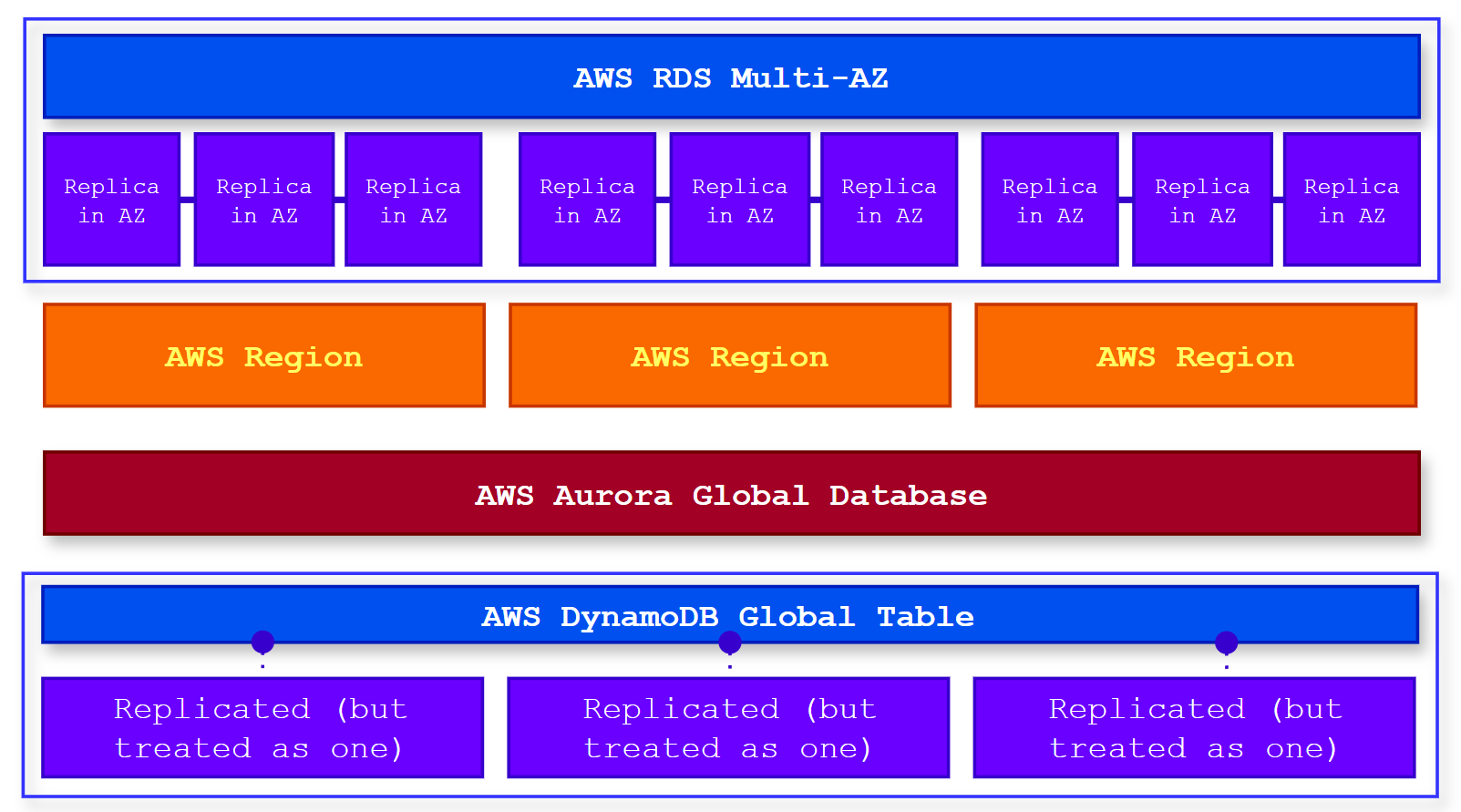
AWS Aurora Global Databases are singular database instances that span multiple AWS Regions (as opposed to AWS DynamoDB Global Tables which are comprised of many replicated tables treated as one).
AWS DynamoDB
- Managed serverless NoSQL database
- Provisioned and optional auto-scaling capacity
- DAX cluster for read cache
- Automated backups up to
35 Days - Event processing - DynamoDB Streams integrate with AWS Lambda or Kinesis Data Streams
- Highly available, multiple Availability Zones
- Decoupled Reads and Writes
DynamoDB Accelerator
- DynamoDB Accelerator (DAX) is a fully managed in-memory cache for AWS DynamoDB offering 10x performance.
- Deployed as a cluster.
DynamoDB Global Tables
AWS DynamoDB Global Tables are comprised of many replicated tables distributed across several AWS Regions so that they:
- Are treated as one sharing
- Share the same primary key schema
AWS ElastiCache
Caches database data using Redis or Memcached:
- Redis:
- Supports Sets and Sorted Sets
- Backup and restore features
- Read replicas for High Availability
- Multiple Availability Zones
- Memcached:
- No High Availability
- No backup and restore
- Multithreaded
AWS Neptune
- Fully managed Graph Database
- Highly available across
3Availability Zones - Up to
15read replicas
AWS Keyspaces
- A managed Apache Cassandra-compatible database service
- Tables are replicated
3times across multiple Availability Zones - Auto-scales Tables up and down based on traffic
- Uses Cassandra Query Language (CQL)
AWS Quantum Ledger
- 2-3x better performance than common ledger blockchain frameworks
- Can use SQL
- Fully managed, serverless, with high availability replication across
3Availability Zones - An immutable ledger
AWS SAA-C03: S3
- Replication
- (File) Versioning
AWS S3 Storage Classes
- S3 Standard
S3 Standard
- S3 Intelligent-Tiering
S3 Intelligent-Tiering
- S3 Standard-Infrequent Access
S3 Standard-IA
- S3 One Zone-Infrequent Access
S3 One Zone-IA
- Archive
- S3 Glacier Instant Retrieval
- S3 Glacier Flexible Retrieval
- S3 Glacier Deep Archive
Note S3 Glacier has been renamed S3 Glacier Flexible Retrieval.
Pricing
AWS users pay for:
- Hosting data in AWS S3
- Updating or Copying data already in AWS S3
- Requests made against items hosted in AWS S3
AWS users don't pay for:
- There is no cost for uploading data into AWS S3 itself
- Although one might pay for transmitting data into a VPC or across AWS Regions
AWS S3 Data Retention
- Glacial Vaults
- S3 Object Lock - Retention Mode
- Governance mode - some special permissions can alter
- Compliance mode - no one one can alter
- S3 Object Lock - Retention Period
- Legal Hold - locked until removed
- Retention Period - a specified period of time
AWS S3 Bucket Security Features
- MFA -Multi-Factor Authentication
- Can be required for deletes
- Used to protect resources
- By URL:
- CORS - Cross-Origin Resource Sharing - restrict resource access when not on same Domain
- Pre-Signed URLs - white list which URLs S3 GET / PUT requests can come from
- File Encryption - Server-Side Encryption (SSE)
- SSE-S3 - default
- SSE-KMS - SSE with AWS KMS
- SSE-C - SSE with Customer Provided Keys
- Bucket Policies
Other Features
- S3 Batch Operations - use S3 Batch and the S3 API
- Supports multi-part uploading
- S3 Transfer Accerlation uses intelligent routing to reduce the time and distance it takes to upload and download files from AWS S3
- Versioning
- Supports static site hosting
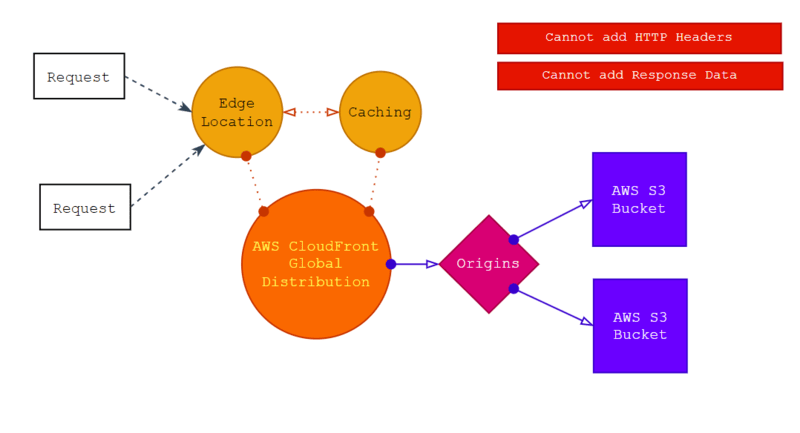
- S3 Origins specify where AWS S3 gets content from to serve to viewers.
- Examples:
- An S3 Bucket
- An HTTP server running on AWS EC2
- Examples:
Static Websites
Allowed URL formats:
http://bucket-name.s3-website.Region.amazonaws.comhttp://bucket-name.s3-website-Region.amazonaws.com
Resources and Links
AWS SAA-C03: EC2
AWS EC2 Instance Purchasing Options
- On-Demand - Pay by the second
- Reserved - Reserve for
1or3years - Spot - Request unused EC2 instances on the fly
- Dedicated Hosts - Pay for a physical host that is fully dedicated to running your instances
- Dedicated Instances - Pay by the hour for instances that run on single-tenant hardware
- On-Demand Capacity Reservations - Reserve capacity for your instances in a specific Availability Zone for any duration.
Scheduled Reserved instances aren't presently offered.
Savings Plans can be used to reduce costs by making a commitment to a consistent amount of usage for
1or3years.
AWS EC2 Reserved Instances
Reserved Instances - Reserved for 1 or 3 years.
Generally speaking, All Upfront payments will be lower in the long-run than No Upfront payments.
- All Upfront - Complete payment at the start regardless of hours eventually used
- Partial Upfront - Portion paid at the start with the remainder being billed at a fixed rate regardless of hours eventually used
- No Upfront - Billed at a fixed rate regardless of hours eventually used
Reserved Instances have a Convertible payment option:
- Convertible - Can be exchanged with another Convertible Reserved Instance
- You cannot exchange:
- All Upfront Reserved Instances for No Upfront Convertible Reserved Instances.
- Partial Upfront Reserved Instances for No Upfront Convertible Reserved Instances.
AWS EC2 Instance Types
- General Purpose - Balanced storage, compute, and memory
Mnomenclature (M5a,M6zn, etc.)
- Compute Optimized - High-performance computing
Cnomenclature (C6g,C6i, etc.)
- Memory Optimized - Large-in-memory instances. Great high-memory use resources like MySQL, Caching
Rnomenclature (R6a,R5n, etc.)
- Storage Optimized - High, sequential read and write access to very large data sets on local storage. Great for databases
D,I,Hnomenclature (H1,D3,I3etc.)
Public vs. Private IP
- Public IP - Used on the public, global, internet/web. Not too Public IP Addresses can be the same
- Private IP - Used within private, subnets
Placement Groups
- Cluster - Same rack, Availability Zone. Fastest but most susceptible to risk factors
- Spread - All the EC2 Instances are deployed on different hardware, Availability Zones, etc.
- Maximizes High Availability
- Limited to
7Instances per Availability Zone
- Partitions - Think muliple Cluster Placement Groups spread across multiple Availability Zones
- Up to
100sof Instances per Partition - Up to
7Partitions per Availability Zone
- Up to
Elastic Network Interfaces
- Can be attached and detached to EC2 Instances within the same Availability Zone
- Used to assign a fixed Public or Private IP Address
AWS EC2 Hibernate
- Stores RAM into a persistent state on an encrypted root EBS volume
- Relaunching or restarting the Instance is much faster
Instance Store, EBS, and EFS
Root Volumes:
- Can be an Instance Store
- Limited to 10GB
- Ephemeral stores for use with temporary data
- Or a EBS Backed Root Volume
- Limited to 1TB
Comparison:
- Instance Store:
- 1-1 with an Instance
- Has good I/O performance since they are directly attached
- They're ephemeral however and when they're lost, the Instance is lost and when they are turned off all persisted data is lost
- Elastic Block Storage:
- Attach to one Instance at a time
- Locked at the Availability Zone (cannot be moved to another Availability Zone without a Restoration Snapshot)
- Better for long-term storage than Instance Stores
- Elastic File Storage:
- Attaches to multiple (hundreds) Instances across the same Availability Zone a time
- Not limited to a single Availability Zone however
- Typically more expensive
- Networked storage
Load Balancers
AWS offers Elastic Load Balancer as a managed service. It comes in a few varieties:
- Application Load Balancer:
- Layer 7 (HTTP), HTTP/2, WebSocket, HTTPS
- Application balancing
- Routing based on URL Path, Hostname, Query, Headers
- Routes to EC2 Instances, ECS Tasks, Lambda Functions, IP Address
- Network Load Balancer:
- Layer 4 (TCP), TCP/UDP forwarding
- Extreme performance
- Routes based on IP Address not specific AWS service
- Gateway Load Balancer:
- Layer 3 (Network), IP packets
- Uses Route Tables to route traffic for an entire VPC
- Primary use is to be the single place for all inbound traffic: firewall, security monitoring, packet analysis, etc.
Classic Load Balancers are being deprecated at the end of 2022.
The Sticky Session feature ensures that users are only connected to the same EC2 Instance (and the same application session, context).
Cross Zone Load Balancing:
- Load balancing is split between all Instances across all Availability Zones
- Otherwise each Instance in an Availability Zone will divide the assigned load balancing weight (for that Availability Zone) by the total number of Instances within that single Availability Zone
Auto-Scaling Groups
- EC2 Instances can be combined into Auto-Scaling Groups
- EC2 Auto Scaling Launch Templates
- EC2 Auto Scaling Launch Configuration
- As a general rule of thumb: EC2 Auto Scaling Launch Templates > Launch Configurations
- They (Templates) provide moer configuration features
- They support multiple versions
- Templates are AWS-recommended
- The EC2 Instance with the oldest Launch Configuration is terminated first
- They create new Instances and terminate them based on configureable triggers and Dynamic Scaling Policies
- For example: CloudWatch alarms
- Auto-Scaling Group Minimum and Maximum Capacities apply to the total number of EC2 Instances across all Availability Zones
Lifecycle
- Scaling Out takes precedence to Scaling In
- New EC2 Instances are launched before new ones are removed
- Scaling In terminates EC2 Instances
- By default, the EC2 Instance with the oldest Launch Configuration is terminated first
Resources and Links
AWS SAA-C03: Containers
AWS Elastic Container Service
AWS ECS automatically increases and decreases the number of ECS Tasks.
- ECS Auto Scaling Uses AWS Application Auto Scaling.
- Target Tracking - scale based on a target CloudWatch Metric value.
- Step Scaling - scale based on specified CloudWatch Alarm.
- Scheduled Scaling - scale based on date/time.
- If using the EC2 Launch Type:
- Auto Scaling Group Scaling - based on CPU usage.
- ECS Cluster Capacity Provider - allows EC2 Instances to be added based on missing capacity.
ECS Launch Types:
- EC2
- Launch Docker containers on AWS.
- User provisions and mainttains the infrastructure (underlying EC2 Instances).
- Fargate
- User just creates the Task Definitions.
- Serverless computing.
- User doesn't manage the underlying EC2 Instances.
IAM Roles:
- EC2 Instance Profile
- EC2 Launch Type only.
- ECS Task Role
- Assigned to a Task.
AWS Elastic Container Registry
- Store and manage Docker images on AWS.
- Private and Public repository.
- Backed by S3.
- Access via IAM permission.
AWS Elastic Kubernetes Service
- Supports ECS.
- Managed Node Groups.
- Self-Managed Nodes.
- AWS native solution for Kubernetes.
AWS AppRunner
- Fully managed app service.
- Builds and deploys apps.
AWS SAA-C03: Serverless
Serverless Computing is a paradigm where infrastructure is sold as a service (IAAS) in a fully managed way (abstracting away the underlying bare metal and operating system resources).
AWS Fargate
- The user creates Task Definitions but AWS manages the rest of the ECS infrastructure
- Limited to:
- 100 Tasks per Region per Account (default)
- 1,000 Tasks per Service
- By Amazon ECS Service Quotas (limits)
Consult the Elastic Container Service article.
https://docs.aws.amazon.com/AmazonECS/latest/developerguide/service-quotas.html
AWS Lambda
- A user creates Lambda Functions but doesn't have to manage the underlying infrastructure to execute them.
- Lambda Functions are associated with specific Endpoints in AWS API Gateway and are invoked using standard HTTP REST methods and URL context paths.
- Lambda Functions are stateless.
- Indeed, they are ideal for stateless
- There's a small delay when a Lambda Function is first called.
- A Lambda Function Context is created from a Cold state (the underlying resources are initialized and made available).
- However, a Lambda Function Contexts exists for
15 minutesin a Hot state. - So, sequential calls will execute without the initial delay.
- Lambda Functions will timeout after
15 minutes. - The default maximum number of simultaneous concurrent connections for a single Lambda Function is
1000within the same AWS Region (this can be increased by request).
IAM Policies
- Execution Roles - grant a Lambda Function permission to access other resources or perform certain operations.
- Resource-Based Policy - how a Lamba Function itself can be used, invoked, or called by users or other services.
AWS API Gateway
- Connect AWS Lambda Functions to API Gateway Endpoints.
- Associate each endpoint with HTTP methods (
PUT,POST,GET,DELETE,PATCH,OPTIONS). - Can define HTTP Request and Response Schemas.
AWS Step Functions
- For sequential or "chained" operations that might require a lengthy or significant amount of execution time.
Serverless Stack
A commonly found and fully Serverless stack will comprise:
- AWS DynamoDB - fully managed serverless DB.
- AWS DynamoDB DAX - for Caching and read acceleration
- AWS Lambda
- AWS Cognito - for identity management and user authentication
AWS Proton
AWS Proton standardizes serveless architecture deployments.
Resources and Links
AWS SAA-C03: Machine Learning
Image Recognition
AWS Rekognition
- Facial analysis and search using Machine Learning (ML) for user verification.
- Find objects, people, text, and images in photos or video.
Speech and Text
AWS Transcribe
- Automatically convert speech to text.
- Deep Learning (Automatic Speech Recognition - ASR)
AWS Polly
- Convert text into speech.
AWS Translate
- Language translation.
AWS Lex + Connect
- Automatic Speech Recognition (ASR) to convert speech into text.
- Natural Language Understanding to recognize the intent of text, callers.
- For chatbots, call center bots.
- Receive calls, create contact flows, cloud-based virtual contact center.
AWS Comprehend
- Natural Language Processing (NLP) to find insights and relationships in text.
- Fully managed, serverless.
- Specialized service for unstructured medical/clinical text (HIPAA).
AWS Textract
- Extract text, handwriting, and data from any scanned documents.
- Extrac data from forms and tables.
Fully Managed Services
AWS SageMaker
- Fully managed service for developers to build Machine Learning models.
AWS Forecast
- Fully managed service for developers to build highly accurate forecasts.
AWS Kendra
- Fully managed document search service.
- Extracts answers from within a document.
- Natural language search capabilities.
AWS Personalize
- Fully managed service for making real-time personalized recommendations.
AWS DOP-C02: Overview


Notes I took before passing the AWS Certified DevOps Engineer - Professional (DOP-C02) Exam.
Test Topics
- Domain 1: SDLC Automation -
22% of scored content- 1.1: Implement CI/CD pipelines.
- Software development lifecycle (SDLC) concepts, phases, and models
- Pipeline deployment patterns for single- and multi-account environments
- Configuring code, image, and artifact repositories
- Using version control to integrate pipelines with application environments
- Setting up build processes (for example, AWS CodeBuild)
- Managing build and deployment secrets (for example, AWS Secrets Manager, AWS Systems Manager Parameter Store)
- Determining appropriate deployment strategies (for example, AWS CodeDeploy)
- 1.2: Integrate automated testing into CI/CD pipelines.
- Different types of tests (for example, unit tests, integration tests, acceptance tests, user interface tests, security scans)
- Reasonable use of different types of tests at different stages of the CI/CD pipeline
- Running builds or tests when generating pull requests or code merges (for example, CodeBuild)
- Running load/stress tests, performance benchmarking, and application testing at scale
- Measuring application health based on application exit codes
- Automating unit tests and code coverage
- Invoking AWS services in a pipeline for testing
- 1.3: Build and manage artifacts.
- Artifact use cases and secure management
- Methods to create and generate artifacts
- Artifact lifecycle considerations
- Creating and configuring artifact repositories (for example, AWS CodeArtifact, Amazon S3, Amazon Elastic Container Registry [Amazon ECR])
- Configuring build tools for generating artifacts (for example, CodeBuild, AWS Lambda)
- Automating Amazon EC2 instance and container image build processes (for example, EC2 Image Builder)
- 1.4: Deployment strategies for instance, container, and serverless environments.
- Deployment methodologies for various platforms (for example, Amazon EC2, Amazon Elastic Container Service [Amazon ECS], Amazon Elastic Kubernetes Service [Amazon EKS], Lambda)
- Application storage patterns (for example, Amazon Elastic File System [Amazon EFS], Amazon S3, Amazon Elastic Block Store [Amazon EBS])
- Mutable deployment patterns in contrast to immutable deployment patterns
- Tools and services available for distributing code (for example, CodeDeploy, EC2 Image Builder)
- Configuring security permissions to allow access to artifact repositories (for example, AWS Identity and Access Management [IAM], CodeArtifact)
- Configuring deployment agents (for example, CodeDeploy agent)
- Troubleshooting deployment issues
- Using different deployment methods (for example, blue/green, canary)
- 1.1: Implement CI/CD pipelines.
- Domain 2: Configuration Management and IaC -
17% of scored content- 2.1: Define cloud infrastructure and reusable components to provision and manage systems throughout their lifecycle.
- Infrastructure as code (IaC) options and tools for AWS
- Change management processes for IaC-based platforms
- Configuration management services and strategies
- Composing and deploying IaC templates (for example, AWS Serverless Application Model [AWS SAM], AWS CloudFormation, AWS Cloud Development Kit [AWS CDK])
- Applying CloudFormation StackSets across multiple accounts and AWS Regions
- Determining optimal configuration management services (for example, AWS OpsWorks, AWS Systems Manager, AWS Config, AWS AppConfig)
- Implementing infrastructure patterns, governance controls, and security standards into reusable IaC templates (for example, AWS Service Catalog, CloudFormation modules, AWS CDK)
- 2.2: Deploy automation to create, onboard, and secure AWS accounts in a multi-account or multi-Region environment.
- AWS account structures, best practices, and related AWS services
- Standardizing and automating account provisioning and configuration
- Creating, consolidating, and centrally managing accounts (for example, AWS Organizations, AWS Control Tower)
- Applying IAM solutions for multi-account and complex organization structures (for example, SCPs, assuming roles)
- Implementing and developing governance and security controls at scale (AWS Config, AWS Control Tower, AWS Security Hub, Amazon Detective, Amazon GuardDuty, AWS Service Catalog, SCPs)
- 2.3: Design and build automated solutions for complex tasks and large-scale environments.
- AWS services and solutions to automate tasks and processes
- Methods and strategies to interact with the AWS software-defined infrastructure
- Automating system inventory, configuration, and patch management (for example, Systems Manager, AWS Config)
- Developing Lambda function automations for complex scenarios (for example, AWS SDKs, Lambda, AWS Step Functions)
- Automating the configuration of software applications to the desired state (for example, OpsWorks, Systems Manager State Manager)
- Maintaining software compliance (for example, Systems Manager)
- 2.1: Define cloud infrastructure and reusable components to provision and manage systems throughout their lifecycle.
- Domain 3: Resilient Cloud Solutions -
15% of scored content- 3.1: Implement highly available solutions to meet resilience and business requirements.
- Multi-AZ and multi-Region deployments (for example, compute layer, data layer)
- SLAs
- Replication and failover methods for stateful services
- Techniques to achieve high availability (for example, Multi-AZ, multi-Region)
- Translating business requirements into technical resiliency needs
- Identifying and remediating single points of failure in existing workloads
- Enabling cross-Region solutions where available (for example, Amazon DynamoDB, Amazon RDS, Amazon Route 53, Amazon S3, Amazon CloudFront)
- Configuring load balancing to support cross-AZ services
- Configuring applications and related services to support multiple Availability Zones and Regions while minimizing downtime
- 3.2: Implement solutions that are scalable to meet business requirements.
- Appropriate metrics for scaling services
- Loosely coupled and distributed architectures
- Serverless architectures
- Container platforms
- Identifying and remediating scaling issues
- Identifying and implementing appropriate auto scaling, load balancing, and caching solutions
- Deploying container-based applications (for example, Amazon ECS, Amazon EKS)
- Deploying workloads in multiple Regions for global scalability
- Configuring serverless applications (for example, Amazon API Gateway, Lambda, AWS Fargate)
- 3.3: Implement automated recovery processes to meet RTO and RPO requirements.
- Disaster recovery concepts (for example, RTO, RPO)
- Backup and recovery strategies (for example, pilot light, warm standby)
- Recovery procedures
- Testing failover of Multi-AZ and multi-Region workloads (for example, Amazon RDS, Amazon Aurora, Route 53, CloudFront)
- Identifying and implementing appropriate cross-Region backup and recovery strategies (for example, AWS Backup, Amazon S3, Systems Manager)
- Configuring a load balancer to recover from backend failure
- 3.1: Implement highly available solutions to meet resilience and business requirements.
- Domain 4: Monitoring and Logging -
15% of scored content- 4.1: Configure the collection, aggregation, and storage of logs and metrics.
- How to monitor applications and infrastructure
- Amazon CloudWatch metrics (for example, namespaces, metrics, dimensions, and resolution)
- Real-time log ingestion
- Encryption options for at-rest and in-transit logs and metrics (for example, client-side and server-side, AWS Key Management Service [AWS KMS])
- Security configurations (for example, IAM roles and permissions to allow for log collection)
- Securely storing and managing logs
- Creating CloudWatch metrics from log events by using metric filters
- Creating CloudWatch metric streams (for example, Amazon S3 or Amazon Kinesis Data Firehose options)
- Collecting custom metrics (for example, using the CloudWatch agent)
- Managing log storage lifecycles (for example, S3 lifecycles, CloudWatch log group retention)
- Processing log data by using CloudWatch log subscriptions (for example,Kinesis, Lambda, Amazon OpenSearch Service)
- Searching log data by using filter and pattern syntax or CloudWatch Logs Insights
- Configuring encryption of log data (for example, AWS KMS)
- 4.2: Audit, monitor, and analyze logs and metrics to detect issues.
- Anomaly detection alarms (for example, CloudWatch anomaly detection)
- Common CloudWatch metrics and logs (for example, CPU utilization with Amazon EC2, queue length with Amazon RDS, 5xx errors with an Application Load Balancer [ALB])
- Amazon Inspector and common assessment templates
- AWS Config rules
- AWS CloudTrail log events
- Building CloudWatch dashboards and Amazon QuickSight visualizations
- Associating CloudWatch alarms with CloudWatch metrics (standard and custom)
- Configuring AWS X-Ray for different services (for example, containers, API Gateway, Lambda)
- Analyzing real-time log streams (for example, using Kinesis Data Streams)
- Analyzing logs with AWS services (for example, Amazon Athena, CloudWatch Logs Insights)
- 4.3: Automate monitoring and event management of complex environments.
- Event-driven, asynchronous design patterns (for example, S3 Event Notifications or Amazon EventBridge events to Amazon Simple Notification Service [Amazon SNS] or Lambda)
- Capabilities of auto scaling for a variety of AWS services (for example, EC2 Auto Scaling groups, RDS storage auto scaling, DynamoDB, ECS capacity provider, EKS autoscalers)
- Alert notification and action capabilities (for example, CloudWatch alarms to Amazon SNS, Lambda, EC2 automatic recovery)
- Health check capabilities in AWS services (for example, ALB target groups, Route 53)
- Configuring solutions for auto scaling (for example, DynamoDB, EC2 Auto
- Scaling groups, RDS storage auto scaling, ECS capacity provider)
- Creating CloudWatch custom metrics and metric filters, alarms, and notifications (for example, Amazon SNS, Lambda)
- Configuring S3 events to process log files (for example, by using Lambda) and deliver log files to another destination (for example, OpenSearch Service, CloudWatch Logs)
- Configuring EventBridge to send notifications based on a particular event pattern
- Installing and configuring agents on EC2 instances (for example, AWS Systems Manager Agent [SSM Agent], CloudWatch agent)
- Configuring AWS Config rules to remediate issues
- Configuring health checks (for example, Route 53, ALB)
- 4.1: Configure the collection, aggregation, and storage of logs and metrics.
- Domain 5: Incident and Event Response -
14% of scored content- 5.1: Manage event sources to process, notify, and take action in response to events.
- AWS services that generate, capture, and process events (for example, AWS Health, EventBridge, CloudTrail)
- Event-driven architectures (for example, fan out, event streaming, queuing)
- Integrating AWS event sources (for example, AWS Health, EventBridge, CloudTrail)
- Building event processing workflows (for example, Amazon Simple Queue Service [Amazon SQS], Kinesis, Amazon SNS, Lambda, Step Functions)
- 5.2: Implement configuration changes in response to events.
- Fleet management services (for example, Systems Manager, AWS Auto Scaling)
- Configuration management services (for example, AWS Config)
- Applying configuration changes to systems
- Modifying infrastructure configurations in response to events
- Remediating a non-desired system state
- 5.3: Troubleshoot system and application failures.
- AWS metrics and logging services (for example, CloudWatch, X-Ray)
- AWS service health services (for example, AWS Health, CloudWatch, Systems Manager OpsCenter)
- Root cause analysis
- 5.1: Manage event sources to process, notify, and take action in response to events.
- Domain 6: Security and Compliance -
17% of scored content- 6.1: Implement techniques for identity and access management at scale.
- Appropriate usage of different IAM entities for human and machine access (for example, users, groups, roles, identity providers, identity-based policies, resource-based policies, session policies)
- Identity federation techniques (for example, using IAM identity providers and AWS IAM Identity Center)
- Permission management delegation by using IAM permissions boundaries
- Organizational SCPs
- Designing policies to enforce least privilege access
- Implementing role-based and attribute-based access control patterns
- Automating credential rotation for machine identities (for example, Secrets Manager)
- Managing permissions to control access to human and machine identities (for example, enabling multi-factor authentication [MFA], AWS Security Token Service [AWS STS], IAM profiles)
- 6.2: Apply automation for security controls and data protection.
- Network security components (for example, security groups, network ACLs, routing, AWS Network Firewall, AWS WAF, AWS Shield)
- Certificates and public key infrastructure (PKI)
- Data management (for example, data classification, encryption, key management, access controls)
- Automating the application of security controls in multi-account and multi-Region environments (for example, Security Hub, Organizations, AWS Control Tower, Systems Manager)
- Combining security controls to apply defense in depth (for example, AWS Certificate Manager [ACM], AWS WAF, AWS Config, AWS Config rules, Security Hub, GuardDuty, security groups, network ACLs, Amazon Detective, Network Firewall)
- Automating the discovery of sensitive data at scale (for example, Amazon Macie)
- Encrypting data in transit and data at rest (for example, AWS KMS, AWS CloudHSM, ACM)
- 6.3: Implement security monitoring and auditing solutions
- Security auditing services and features (for example, CloudTrail, AWS Config, VPC Flow Logs, CloudFormation drift detection)
- AWS services for identifying security vulnerabilities and events (for example, GuardDuty, Amazon Inspector, IAM Access Analyzer, AWS Config)
- Common cloud security threats (for example, insecure web traffic, exposed AWS access keys, S3 buckets with public access enabled or encryption disabled)
- Implementing robust security auditing
- Configuring alerting based on unexpected or anomalous security events
- Configuring service and application logging (for example, CloudTrail, CloudWatch Logs)
- Analyzing logs, metrics, and security findings
- 6.1: Implement techniques for identity and access management at scale.
Resources and Links
- https://d1.awsstatic.com/training-and-certification/docs-devops-pro/AWS-Certified-DevOps-Engineer-Professional_Exam-Guide.pdf
- https://community.aws/content/2bzw7c842qEPoOHN8ZqFQh30Cb9/the-complete-package-to-passing-the-aws-devops-engineer-pro-dop-c02-certification?lang=en
- https://www.credly.com/badges/91afcc01-231a-4267-8093-c93a73528653
AWS DOP-C02: Domain 1
Notes about specific subtopics.
SDLC Automation
Task Statement 1.1: Implement CI/CD pipelines:
- Continuous Integration and Continuous Delivery (CI/CD)
- Continuous Delivery stops short of automating Production deployments by requiring manual approval to do so.
- Continuous Integration and Continuous Deployment (CI/CD)
- Continuous Deployment deploys code all the way to Production automatically.
- AWS CodeCommit - Git, Code, Versioning
- Now deprecated but may still be tested in the DOP-CO2 exam.
- Offered some security advantages over GitHub, BitBucket, and GitLab:
- Private Git Repositories within the same AWS VPC.
- Can use AWS IAM Policies to manage AWS IAM Roles, SSH Keys, and AWS IAM Users.
- AWS CLI can manage Git credentials (in addition to other AWS credentials).
- AWS KMS can be used for encryption of files at rest or in transit.
- Drawback: minimal User Interface.
- AWS CodePipeline - Continuous Delivery Service
- Define Pipelines to Build and Deploy Source Code from a variety of sources to defined Deployments.
- Events
- Event-Driven Triggers defined through AWS EventBridge or AWS CodeStar Source Connection
- Webhooks
- Scripted Webhook is defined and Deployed.
- Polling
- CodePipeline polls changes in a GitHub Repository.
- Supports Continuous Delivery (which requires an Approver) as well as Continuous Deployment (which Deploys all the way to an Environment automatically).
- Can define a Manual Approval through AWS IAM and AWS SNS.
Example CI/CD: GitHub -> Elastic Beanstalk -> CodePipeline
- Node.js application Source Code is checked into a GitHub Repository.
- The GitHub Repository and target Branch are associated with an AWS Elastic Beanstalk Environment and AWS Elastic Beanstalk Application.
- An AWS CodePipeline Pipeline is defined to Trigger a Build and the Deploy all changes into the target AWS Elastic Beanstalk Environment on any Commit.
Also: https://github.com/Thoughtscript/aws_dop_c02/blob/main/08_templates/README.md#lab
Example CI/CD: Docker -> ECR -> ECS
- Docker Image(s) is built locally.
- Docker Image(s) is pushed to an AWS ECR Repository.
- AWS ECS Fargate - Task Definition points to URL of the AWS ECR Repository to retrieve Docker Image.
- Application Load Balancers, private Subnets, and/or public Subnets are defined and selected for deployment into.
- The AWS ECS Fargate - Task Definition gets deployed as a Managed, Serverless, AWS ECS Task.
Example CI/CD: GitHub -> S3 -> CodeBuild -> Lambda
- Python Lambda Handler is checked into a GitHub Repository with a
buildspec.yml. - The GitHub Repository is associated with AWS CodeBuild.
- The GitHub Repository is zipped and saved as an Artifact on AWS S3.
- An AWS Lambda Function is defined and associated with the AWS S3 Artifact.
- The AWS Lambda Function is deployed and made accessible through an AWS API Gateway.
Configuration
General Deployment Strategies
General Deployment Strategies that are often combined.
| Strategy | Description |
|---|---|
In-Place |
Each Instance to be updated is stopped and the target version started. |
Blue/Green |
Shifting traffic between two versions (gradually or otherwise). |
Canary |
Target version is deployed for only a predetermined fraction of overall traffic. |
Linear |
Traffic to the target version is gradually increased in equal increments over a fixed interval of time. |
All-at-Once |
Traffic is immediately shifted to the target version. |
https://docs.aws.amazon.com/whitepapers/latest/introduction-devops-aws/deployment-strategies.html
Elastic Beanstalk Deployment Settings
| Setting | Description | General Deployment Strategy(ies) | Downtime, Deployment Time | Deployment To | Impact of Failed Deploy |
|---|---|---|---|---|---|
| All at Once | Deploy all Instances immediately and at once. | All-at-Once, In-Place |
Downtime while new Instances Deployed, Fastest. | Existing Instances. | Signifcant, requires Manual Redeployment. |
| Rolling (with Additional Batch) | Deploy new Instances in successive batches. | In-Place |
Zero, Second fastest. | New and Existing Instances. | Typically Minimal, Manual Redeploy (and removal) of Batch. |
| Immutable | New Instances are created and traffic is shifted to them as they pass health checks. | Blue/Green |
Zero, Slowest. | New Instances. | Minimal, Terminate New Instances. |
| Traffic-Splitting | Traffic is split between deployments. | Blue/Green. Can be Linear, Canary. |
Zero, Slowest. | New Instances. | Minimal, Swap DNS/URL Settings. |
The above Deployment Strategies are often confused or conflated. For instance here, the AWS Documentation verbatim states: "The goal of blue/green deployments is to achieve immutable infrastructure" - they are distinct but are often used together.
AWS EC2 Deployment Settings
file_exists_behavior
| Setting | Description |
|---|---|
DISALLOW |
Default. If existing files are present, the deployment fails. |
OVERWRITE |
Any prior files are overridden by the current deployment. |
RETAIN |
Prior files are kept and matching files in the current deployment are ignored. |
https://docs.aws.amazon.com/codedeploy/latest/userguide/reference-appspec-file-structure-files.html
Build Variables
| AWS Service/Feature | Description | Use and Limits |
|---|---|---|
| AWS Systems Manager Parameter Store | Remove Application and Environment Secrets from plaintext and securely store. | Key-Value pairs encrypted through AWS KMS, for general use (not just Secrets), 4-8 KB max size, can Notify about but not Rotate Secrets. |
| AWS AppConfig | Support for JSON Schema Validation, managing complex multi-valued Application configurations. | Integrates with AWS Systems Manager Parameter Store, S3. |
| AWS CloudFormation Cross-References | Reference other CloudFormation Templates, Stacks, and outputs. | AWS CloudFormation-specific. |
Resources and Links
- https://docs.aws.amazon.com/elasticbeanstalk/latest/dg/using-features.rolling-version-deploy.html
- https://docs.aws.amazon.com/elasticbeanstalk/latest/dg/using-features.rolling-version-deploy.html#environments-cfg-rollingdeployments-namespace
- https://docs.aws.amazon.com/whitepapers/latest/introduction-devops-aws/deployment-strategies.html
- https://docs.aws.amazon.com/codedeploy/latest/userguide/reference-appspec-file-structure-files.html
- https://docs.aws.amazon.com/AWSCloudFormation/latest/UserGuide/walkthrough-crossstackref.html
Code samples:
AWS DOP-C02: Domain 2
Notes about specific subtopics.
Configuration Management and IaC
Lambda SDK's
| AWS Service | Description | Use and Limits |
|---|---|---|
| AWS Serverless Application Model (SAM) | Great for fastly building AWS Lambda Functions and testing locally. | Older, uses YAML Templates. |
| AWS Cloud Development Kit (CDK) | Considered more recent/advanced, uses Constructs. | High-level, support for many languages, support for Serverless/non-Serverless. |
Automated Solutions
| AWS Service | Description | Use and Limits | Agent-Based |
|---|---|---|---|
| AWS Systems Manager | Manage, Patch, and Access tools for (EC2) Instances. | Primarily used with EC2 for operational tasks. | Yes - SSM. |
| AWS Config | Audits and assesses AWS Resource configurations. | Compliance, conformance, stipulating Organization rules. Can now define AWS Config Managed Rules that audit running workloads. | No |
| AWS Service Catalog | Centrally Whitelist, Manage, and Approve IT Resources (Images, Software, Database, etc.). | Catalog-based, limited Constraint configuration (can restrict by User). | No. |
| AWS CloudFormation | Used to define Stacks and Templates (for complex deployments). | Primarily used for entire Infrastructure-(as-Code) tasks, can't restrict by User. | No. |
Scheduling
| AWS Service Entity | Description | Use and Limits |
|---|---|---|
| AWS EventBridge Scheduler | Scheduling for millions of Serverless Events. | Newer, integrates with AWS Lambda and other Services. |
| AWS EventBridge Rule | Can schedule Cron Jobs to trigger Events. | Older, less scalable, matches Event data. |
| AWS EC2 (Spot) Instances | Can define traditional Cron Jobs within an EC2 Instance. | Can be costly, limited to Container. |
Terraform Samples
Resources and Links
- https://docs.aws.amazon.com/systems-manager/latest/userguide/systems-manager-instances-and-nodes.html
- https://docs.aws.amazon.com/config/latest/developerguide/evaluate-config_use-managed-rules.html
- https://aws.amazon.com/servicecatalog/
- https://docs.aws.amazon.com/servicecatalog/latest/adminguide/portfoliomgmt-constraints.html
- https://docs.aws.amazon.com/cloudformation/
- https://docs.aws.amazon.com/lambda/latest/dg/with-eventbridge-scheduler.html
- https://docs.aws.amazon.com/eventbridge/latest/userguide/eb-scheduled-rule-pattern.html
- https://docs.aws.amazon.com/opsworks/latest/userguide/workingcookbook-extend-cron.html
Code samples:
- https://github.com/Thoughtscript/aws_dop_c02/
- https://github.com/Thoughtscript/aws_dop_c02/tree/main/01_cbl
- https://github.com/Thoughtscript/aws_dop_c02/tree/main/02_ecs
- https://github.com/Thoughtscript/aws_dop_c02/tree/main/03_ecs_ssl
- https://github.com/Thoughtscript/aws_dop_c02/tree/main/08_templates
AWS DOP-C02: Domain 3
Notes about specific subtopics.
Resilient Cloud Solutions
Resilient Databases
| AWS Service | Description | Use and Limits |
|---|---|---|
| AWS Aurora Global Databases | Single, Multi-Region, AWS Aurora database deployment. | Global, multi-Region, globally distributed (not Read Replicas). |
| AWS DynamoDB Global Tables | Multiple AWS DynamoDB Tables that are replicated across many Regions but treated as a single database. | Global, multi-Region, globally distributed (inherently replicated). |
| AWS RDS Multi-AZ Cluster | Read Replicas deployed across multiple Availability Zones within the same Region. | Single Region, Semisynchronous, minimum of 3 AZ's. |
https://render-static-fs.onrender.com/study_guide_notes_2023.html#aws-saa-c03-databases
https://render-static-fs.onrender.com/study_guide_notes_2023.html#aws-certified-cloud-practitioner
Replication
| AWS Service | Description | Use and Limits |
|---|---|---|
| AWS Aurora Replication | Single Region, up to 15 Replicas. |
Read Replication and Query offloading. |
| AWS DynamoDB Replication | Through AWS DynamoDB Global Tables. | Global, multi-Region, globally distributed (inherently replicated). |
| AWS RDS Multi-AZ Replication | Replicas deployed across multiple Availability Zones within the same Region. | Single Region, Read Replicas. AWS RDS Multi-AZ Cluster. |
| AWS RDS Cross-Region Replication | Replicas deployed across multiple Regions. | Multi-Region, Read Replicas. |
AWS DynamoDB Configurations
| Entity | Description | Use and Limits |
|---|---|---|
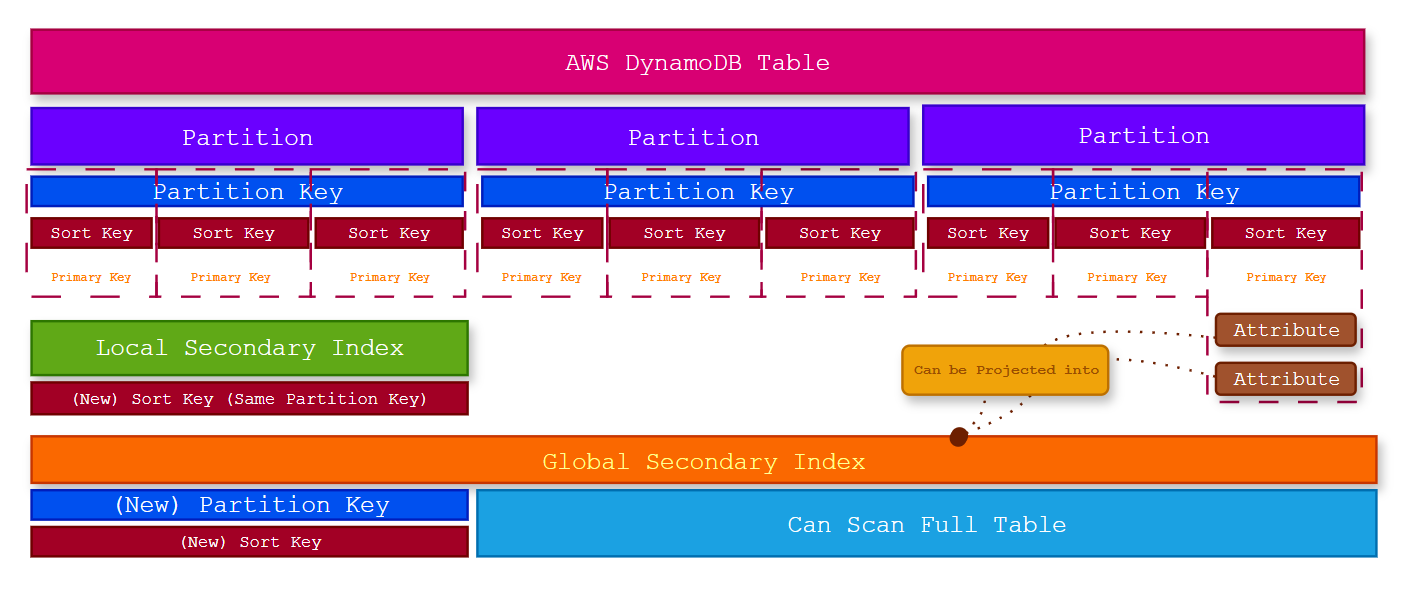
| Global Secondary Index (GSI) | Second index on base table. | New Partition and Sort Keys, no size limits, scans full table. |
| Local Secondary Index (LSI) | Second index on base table. | Same Partition Key, different Sort Key, 10 GB size limit, scans Partition. Must be created when the base table is. |
| Partition | Specified up by Partition Keys. Divides up AWS DynamoDB Tables (of which there are often |
Segments or divides data for querying, organization. |
| Primary Key | Composed of Sort Key and Partition Key. | Global vs Local Secondary Indicies, Partition Key divides Table into Partitions. |
| Projected Attribute | Attributes that are "copied" (Projected) into an Index. | Can be all Attributes (entity). Primary and Index Keys are automatically Projected. |
https://docs.aws.amazon.com/amazondynamodb/latest/developerguide/bp-indexes-general.html
Static Asset Resiliency
| AWS Service | Description | Use and Limits |
|---|---|---|
| AWS S3 Cross Region Replication | Copies data from S3 Buckets across multiple Regions (quickly). | Region specific replication, good for backup/recovery. |
| AWS CloudFront Distribution | Low latency, distribution by edge location. | Eventually consistent, truly Global, good for serving website content. |
https://render-static-fs.onrender.com/study_guide_notes_2023.html#aws-saa-c03-s3
AWS S3 Configuration and Limitations
- Summary of AWS S3 Cross Region Replication configuration steps:
- Permissions are handled through a created IAM Role,
- Bucket Replication from source to destination is enabled.
- Versioning is enabled on both source and destination.
- AWS S3 doesn't support retries (of any sort) natively.
- Instead one must define an Lambda Function to perform S3 retries.
ALB's and VPC's
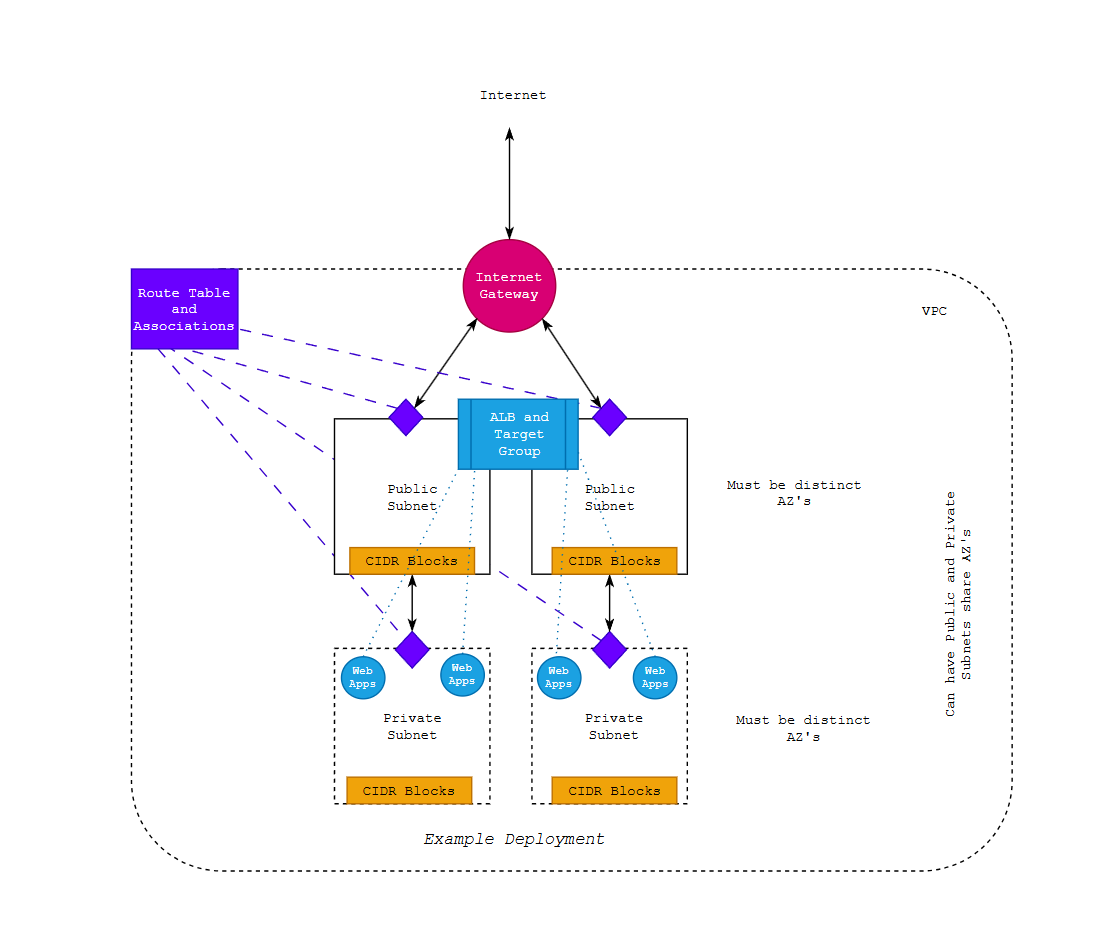
Terraform Samples
- AWS Lambda
- AWS ECS Service Definition
- Target Group Health Checks
- Multi-Region Availability Zones
- EC2 ALB
- EC2, VPC, Subnets, ALB, ACM, SSL, Route 53
Resources and Links
- https://dev.to/megha_shivhare_5038dc1047/aws-cloudfront-vs-s3-cross-region-replication-o0f#:~:text=The%20choice%20between%20CloudFront%20and,replication%20and%20regional%20compliance%20solutions.
- https://docs.aws.amazon.com/AmazonRDS/latest/UserGuide/Concepts.MultiAZ.html
- https://docs.aws.amazon.com/AmazonRDS/latest/UserGuide/Concepts.RDS_Fea_Regions_DB-eng.Feature.CrossRegionReadReplicas.html
- https://docs.aws.amazon.com/amazondynamodb/latest/developerguide/bp-indexes-general.html
- https://docs.aws.amazon.com/amazondynamodb/latest/developerguide/bp-sort-keys.html
- https://docs.aws.amazon.com/amazondynamodb/latest/APIReference/API_Projection.html
- https://docs.aws.amazon.com/amazondynamodb/latest/developerguide/bp-table-design.html
- https://docs.aws.amazon.com/amazondynamodb/latest/developerguide/bp-indexes-general-sparse-indexes.html
- https://docs.aws.amazon.com/amazondynamodb/latest/developerguide/bp-table-design.html
- https://www.timescale.com/blog/benchmarking-amazon-aurora-vs-postgresql
- https://docs.aws.amazon.com/AmazonS3/latest/userguide/replication-requirements.html
- https://docs.aws.amazon.com/AmazonS3/latest/userguide/setting-repl-config-perm-overview.html#setting-repl-config-same-acctowner
Code samples:
AWS DOP-C02: Domain 4
Notes about specific subtopics.
Monitoring and Logging
Logging
| AWS Service | Description | Use and Limits |
|---|---|---|
| AWS CloudWatch | Used with Log Groups, Filters, Alarms, and Metrics to log the performance and operational health of Resources. | Logs performance and operational metrics, health but not internal use (by staff/devs). |
| AWS CloudTrail | Trace HTTP Requests, audit API calls. | Logs User interactions but not operational ones. |
Agents
| AWS Service | Entity | Description | Use and Limits | Logging |
|---|---|---|---|---|
| AWS Systems Manager | Systems Manager Agent (SSM) | AWS Systems Manager Agent (primarily) installed on EC2 Instances. | Used to Update, Patch, Configure, and Manage resources. | Logs can be sent to AWS CloudWatch. |
| AWS CloudWatch | AWS CloudWatch Agent | AWS CloudWatch Agent primarily used to collect Memory, CPU telemetry on EC2 and ECS Instances. | Collects Memory and CPU Telemetry. | Inherently sent to AWS CloudWatch. |
| AWS X-Ray | AWS X-Ray Daemon | Default port 2000, UDP-based tool used to Trace, troubleshoot, and analyze HTTP Request traffic. |
Distributed, deployed through Docker Image. Deployed into a AWS ECS Cluster alongside other Containers. | Used for traffic, UDP, and trace logging. Integrates with AWS CloudWatch. |
https://render-static-fs.onrender.com/study_guide_notes_2023.html#aws-saa-c03-monitoring
Terraform Samples
- AWS Cloud Watch
- Event Processing
- Target Group Health Checks
- EC2 ALB
- EC2, VPC, Subnets, ALB, ACM, SSL, Route 53
Resources and Links
- https://docs.aws.amazon.com/systems-manager/latest/userguide/ssm-agent.html
- https://docs.aws.amazon.com/AmazonCloudWatch/latest/monitoring/install-CloudWatch-Agent-on-EC2-Instance.html
- https://docs.aws.amazon.com/AmazonCloudWatch/latest/monitoring/metrics-collected-by-CloudWatch-agent.html
- https://docs.aws.amazon.com/xray/latest/devguide/xray-concepts.html#xray-concepts-traces
- https://docs.aws.amazon.com/xray/latest/devguide/xray-daemon-ecs.html
Code samples:
AWS DOP-C02: Domain 5
Notes about specific subtopics.
Incident and Event Response
AWS CloudWatch Entities
| AWS CloudWatch Entity | Description | Use and Limits |
|---|---|---|
| Custom Metric | Defined for use within CloudWatch Alarms, Queries, and Metric Filters to monitor events. | Metric are Dimensioned and some operations are reserved for certain data types. |
| Aggregate Function | Inbuilt CloudWatch Insights query functions (count()) akin to those found in SQL. |
Can be used in Queries and Metric Filters manually through CloudWatch Insights. |
| Metric Filter | Used to filter and query logs and log data. Used to define CloudWatch Alarms, populate statistics, and graphs. | Used in the CloudWatch Insights UI/UX console and when defining CloudWatch Alarms. |
Manage Events
| AWS Service | Description | Use and Limits |
|---|---|---|
| Apache Kafka | Open-source Event-based Message Broker using KRaft/ZooKeeper to coordinate. | Supports many Data Formats (JSON), unlimited Retention Period, not-AWS-bound, more configuration options, used with AWS MSK. |
| AWS SQS | AWS-bound Event-based Messaging Queue. | Text, max 14 Day Retention Period, DLQ, and Retry Queues built-in. |
| AWS Kinesis | Collect, process, and analyze real-time streaming data. | Typically used for complex and/or vast data streams. |
https://render-static-fs.onrender.com/study_guide_notes_2023.html#aws-saa-c03-messaging
https://render-static-fs.onrender.com/study_guide_notes_2023.html#aws-saa-c03-other-data-services
Notifications
| AWS Service | Description | Use and Limits |
|---|---|---|
| AWS SES | Primarily intended for Email mass-marketing. | Bulk Email. |
| AWS SNS | Notifications can be connected to a variety of Endpoints. | SMS, Email, Pager Duty Integration, etc. |
Terraform Samples
Resources and Links
- https://docs.aws.amazon.com/AWSSimpleQueueService/latest/SQSDeveloperGuide/sqs-dead-letter-queues.html
- https://docs.aws.amazon.com/AmazonCloudWatch/latest/APIReference/API_Metric.html
- https://docs.aws.amazon.com/AmazonCloudWatch/latest/monitoring/cloudwatch_concepts.html#Dimension
- https://docs.aws.amazon.com/AmazonCloudWatch/latest/monitoring/using-metric-math.html#metric-math-syntax
- https://docs.aws.amazon.com/AmazonCloudWatch/latest/monitoring/cloudwatch-metrics-insights-querylanguage.html
- https://docs.aws.amazon.com/AmazonCloudWatch/latest/monitoring/cloudwatch-metrics-insights-inference.html
Code samples:
AWS DOP-C02: Domain 6
Notes about specific subtopics.
Security and Compliance
AWS IAM
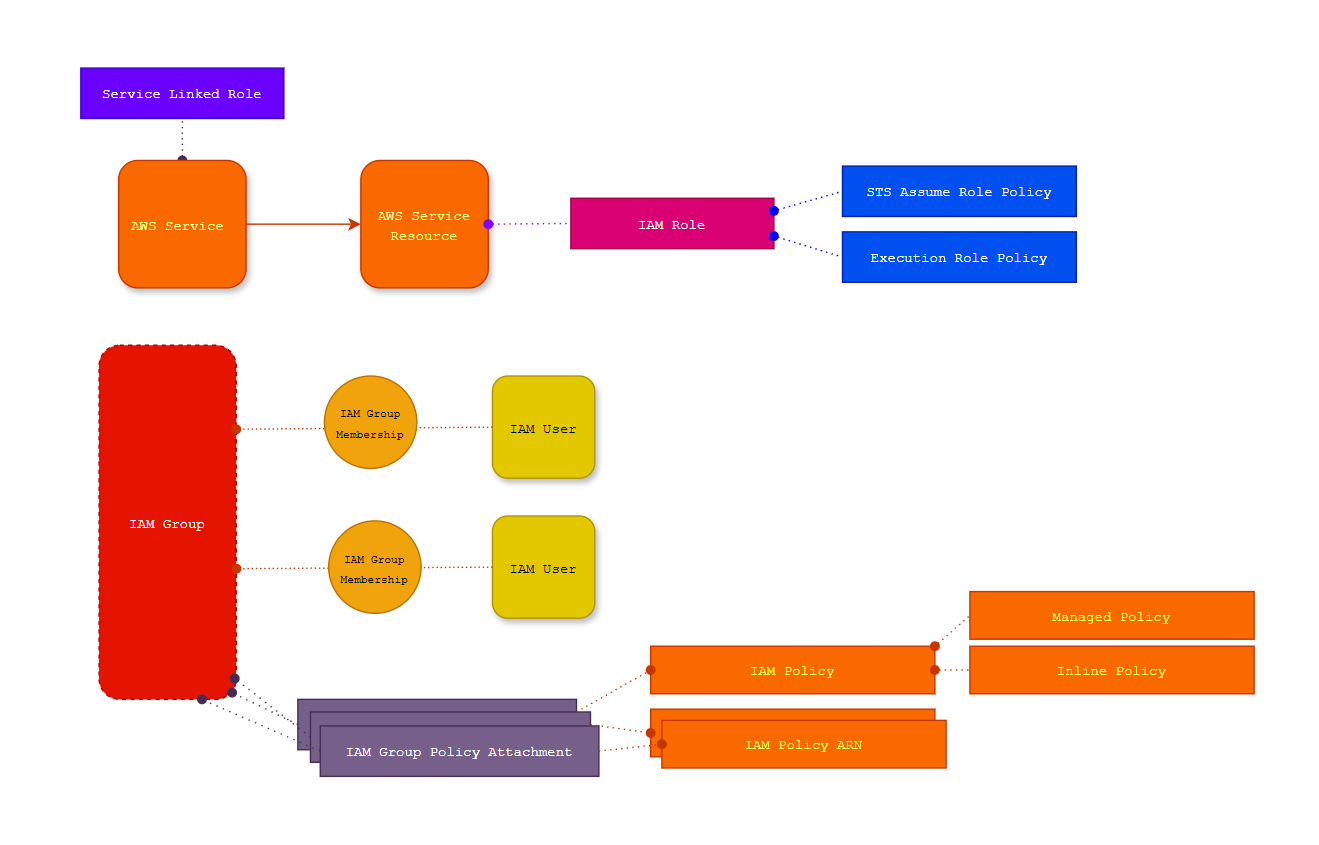
Management and Governance
| AWS Service Entity | Description | Use and Limits | Integrations |
|---|---|---|---|
| AWS Organization Service Control Policies | Used to set AWS IAM permission guardrails. | They do not grant permissions. They limit what IAM permissions or actions can be taken. | AWS IAM, AWS Organizations |
| AWS Config Organizational Rules | Used to manage AWS Config Rules across all Organizations. | Create a common set of AWS Config Rules across all Accounts. | AWS IAM Accounts, AWS Config, AWS Organizations |
| AWS Control Tower | Orchestrates Services across multiple AWS Accounts and Organizational Units (OU's). | Limited to 5 Service Control Policies per OU. Primarily used for automating guardrails across Accounts/OU's. |
AWS Organizations, AWS IAM Accounts, AWS Service Catalog |
https://docs.aws.amazon.com/organizations/latest/userguide/orgs_manage_policies_scps.html
https://docs.aws.amazon.com/config/latest/developerguide/config-rule-multi-account-deployment.html
https://docs.aws.amazon.com/controltower/latest/userguide/what-is-control-tower.html
Secrets Management
| AWS Service | Description | Use and Limits |
|---|---|---|
| AWS Systems Manager Parameter Store | Remove Application and Environment Secrets from plaintext and securely store. | Key-Value pairs encrypted through AWS KMS, for general use (not just Secrets), 4-8 KB max size, can Notify about but not Rotate Secrets. |
| AWS Secrets Manager | Store, Rotate Database and API Credentials. | Can Rotate Secrets automatically, larger max size 64 KB. |
https://tutorialsdojo.com/aws-secrets-manager-vs-systems-manager-parameter-store/
https://render-static-fs.onrender.com/study_guide_notes_2023.html#aws-saa-c03-security
Automated Detection
| AWS Service | Description | Use and Limits |
|---|---|---|
| AWS Macie | Uses Machine Learning to scan AWS S3 Resources for malicious activity. | AWS S3 (only) |
| AWS Guard Duty | Detects malicious activity. | Malicious activity and workload detection across AWS Accounts. |
| AWS Inspector | Automated security inspection - reviews services and Resources for compliance/security conformance. | AWS EC2 (and now AWS Lambda) security compliance and known security vulnerability assessments. Cannot scan AMI's. |
https://render-static-fs.onrender.com/study_guide_notes_2023.html#aws-saa-c03-security
https://render-static-fs.onrender.com/study_guide_notes_2023.html#aws-certified-cloud-practitioner
Environment Management
| AWS Service | Description | Use and Limits |
|---|---|---|
| AWS Trusted Advisor | Best Practice recommendation for AWS Environments. | Guidance and recommendations. Can notify weekly. |
| AWS Config | Audits and assesses AWS Resource configurations. | Compliance, conformance, stipulating Organization rules. Can now define AWS Config Managed Rules that audit running workloads. Remediation rules use AWS Systems Manager Automation Documents not AWS Lambda or AWS Config. Can scan AMI's. |
See: AWS CCP notes on Environment Management.
Compliance: Drift Detection
| AWS Service Entity | Description | Use and Limits |
|---|---|---|
| AWS CloudFormation Drift Detection | Capability of AWS CloudFormation. | Only supports certain Deployment Statuses. |
| AWS Config Config Recorder | Is run to track changes and deviations from some specified target Configuration. | Must be run through AWS Config, can only detect Configurations, is recorded and stored. |
Terraform Samples
- VPC PrivateLink
- VPC Security Groups
- Private VPC
- Private VPC to Public Internet through IGW
- AWS Cognito and Identity Providers
- AWS Route 53 and ACM SSL Certs
Resources and Links
- https://docs.aws.amazon.com/organizations/latest/userguide/orgs_manage_policies_scps.html
- https://docs.aws.amazon.com/config/latest/developerguide/config-rule-multi-account-deployment.html
- https://docs.aws.amazon.com/controltower/latest/userguide/what-is-control-tower.html
- https://tutorialsdojo.com/aws-secrets-manager-vs-systems-manager-parameter-store/
- https://repost.aws/knowledge-center/trusted-advisor-notifications
- https://docs.aws.amazon.com/AWSCloudFormation/latest/UserGuide/detect-drift-stack.html
- https://docs.aws.amazon.com/config/latest/developerguide/managing-recorder_console-change-recording-frequency.html
Code samples:
- https://github.com/Thoughtscript/aws_dop_c02/tree/main/01_cbl
- https://github.com/Thoughtscript/aws_dop_c02/tree/main/03_ecs_ssl
- https://github.com/Thoughtscript/aws_dop_c02/blob/main/09_cog
- https://github.com/Thoughtscript/aws_dop_c02/blob/main/06_conf
- https://github.com/Thoughtscript/aws_dop_c02/blob/main/10_acm_ssl
AWS SAP-C02: Overview


Notes I took before taking the AWS Certified Solutions Architect - Professional (SAP-C02) Exam.
Strongly recommend using the Jon Bonso course on Tutorials Dojo as well as the Official AWS Practice Exam.
Test Topics
- Domain 1: Design Solutions for Organizational Complexity -
26% of scored content- Task 1.1: Architect network connectivity strategies
- Knowledge of:
- AWS Global Infrastructure
- AWS networking concepts (for example, Amazon Virtual Private Cloud (Amazon VPC), AWS Direct Connect, AWS VPN, transitive routing, AWS container services)
- Hybrid DNS concepts (for example, Amazon Route 53 Resolver, on-premises DNS integration)
- Network segmentation (for example, subnetting, IP addressing, connectivity among VPCs)
- Network traffic monitoring
- Skills in:
- Evaluating connectivity options for multiple VPCs
- Evaluating connectivity options for on-premises, co-location, and cloud integration
- Selecting AWS Regions and Availability Zones based on network and latency requirements
- Troubleshooting traffic flows by using AWS tools
- Using service endpoints for service integrations
- Knowledge of:
- Task 1.2: Prescribe security controls
- Knowledge of:
- AWS Identity and Access Management (IAM) and AWS IAM Identity Center
- Route tables, security groups, and network ACLs
- Encryption keys and certificate management - for example, AWS Key Management Service (AWS KMS), AWS Certificate Manager (ACM)
- AWS security, identity, and compliance tools - for example, AWS CloudTrail, AWS Identity and Access Management Access Analyzer, AWS Security Hub, Amazon Inspector
- Skills in:
- Evaluating cross-account access management
- Integrating with third-party identity providers
- Deploying encryption strategies for data at rest and data in transit
- Developing a strategy for centralized security event notifications and auditing
- Knowledge of:
- Task 1.3: Design reliable and resilient architectures
- Knowledge of:
- Recovery time objectives (RTOs) and recovery point objectives (RPOs)
- Disaster recovery strategies (for example, using AWS Elastic Disaster Recovery, pilot light, warm standby, and multi-site)
- Data backup and restoration
- Skills in:
- Designing disaster recovery solutions based on RTO and RPO requirements
- Implementing architectures to automatically recover from failure
- Developing the optimal architecture by considering scale-up and scale-out options
- Designing an effective backup and restoration strategy
- Knowledge of:
- Task 1.4: Design a multi-account AWS environment
- Knowledge of:
- AWS Organizations and AWS Control Tower
- Multi-account event notifications
- AWS resource sharing across environments
- Skills in:
- Evaluating the most appropriate account structure for organizational requirements
- Recommending a strategy for central logging and event notifications
- Developing a multi-account governance model
- Knowledge of:
- Task 1.5: Determine cost optimization and visibility strategies
- Knowledge of:
- AWS cost and usage monitoring tools - for example, AWS Trusted Advisor, AWS Pricing Calculator, AWS Cost Explorer, AWS Budgets
- AWS purchasing options - for example, Reserved Instances, Savings Plans, Spot Instances
- AWS rightsizing visibility tools - for example, AWS Compute Optimizer, Amazon Simple Storage Service (Amazon S3) Storage Lens
- Skills in:
- Monitoring cost and usage with AWS tools
- Developing an effective tagging strategy that maps costs to business units
- Understanding how purchasing options affect cost and performance
- Knowledge of:
- Task 1.1: Architect network connectivity strategies
- Content Domain 2: Design for New Solutions -
29% of scored content- Task 2.1: Design a deployment strategy to meet business requirements
- Knowledge of:
- Infrastructure as code (IaC) (for example, AWS CloudFormation)
- Continuous integration and continuous delivery (CI/CD)
- Change management processes
- Configuration management tools (for example, AWS Systems Manager)
- Skills in:
- Determining an application or upgrade path for new services and features
- Selecting services to develop deployment strategies and implement appropriate rollback mechanisms
- Adopting managed services as needed to reduce infrastructure provisioning and patching overhead
- Making advanced technologies accessible by delegating complex development and deployment tasks to AWS
- Knowledge of:
- Task 2.2: Design a solution to ensure business continuity
- Knowledge of:
- AWS Global Infrastructure
- AWS networking concepts (for example, Amazon Route 53, routing methods)
- RTOs and RPOs
- Disaster recovery scenarios (for example, backup and restore, pilot light, warm standby, multisite)
- Disaster recovery solutions on AWS
- Skills in:
- Configuring disaster recovery solutions
- Configuring data and database replication
- Performing disaster recovery testing
- Architecting a backup solution that is automated, is cost-effective, and supports business continuity across multiple Availability Zones or AWS Regions
- Designing an architecture that provides application and infrastructure availability in the event of a disruption
- Using processes and components for centralized monitoring to proactively recover from system failures
- Knowledge of:
- Task 2.3: Determine security controls based on requirements
- Knowledge of:
- IAM
- Route tables, security groups, and network ACLs
- Encryption options for data at rest and data in transit
- AWS service endpoints
- Credential management services
- AWS managed security services (for example, AWS Shield, AWS WAF, Amazon GuardDuty, AWS Security Hub)
- Skills in:
- Specifying IAM users and IAM roles that adhere to the principle of least privilege access
- Specifying inbound and outbound network flows by using security group rules and network ACL rules
- Developing attack mitigation strategies for large-scale web applications
- Developing encryption strategies for data at rest and data in transit
- Specifying service endpoints for service integrations
- Developing strategies for patch management to remain compliant with organizational standards
- Knowledge of:
- Task 2.4: Design a strategy to meet reliability requirements
- Knowledge of:
- AWS Global Infrastructure
- AWS storage services and replication strategies (for example Amazon S3, Amazon RDS, Amazon ElastiCache)
- Multi-AZ and multi-Region architectures
- Auto scaling policies and events
- Application integration (for example, Amazon SNS, Amazon SQS, AWS Step Functions)
- Service quotas and limits
- Skills in:
- Designing highly available application environments based on business requirements
- Using advanced techniques to design for failure and ensure seamless system recoverability
- Implementing loosely coupled dependencies
- Operating and maintaining high-availability architectures (for example, application failovers, database failovers)
- Using AWS managed services for high availability
- Implementing DNS routing policies (for example, Route 53 latency-based routing, geolocation routing, simple routing)
- Knowledge of:
- Task 2.5: Design a solution to meet performance objectives
- Knowledge of:
- Performance monitoring technologies
- Storage options on AWS
- Instance families and use cases
- Purpose-built databases
- Skills in:
- Designing large-scale application architectures for a variety of access patterns
- Designing an elastic architecture based on business objectives
- Applying design patterns to meet performance objectives with caching, buffering, and replicas
- Developing a process methodology for selecting purpose-built services for required tasks
- Designing a rightsizing strategy
- Knowledge of:
- Task 2.6: Determine a cost optimization strategy to meet solution goals and objectives
- Knowledge of:
- AWS cost and usage monitoring tools (for example, AWS Cost Explorer, AWS Trusted Advisor, AWS Pricing Calculator)
- Pricing models (for example, Reserved Instances, AWS Savings Plans)
- Storage tiering
- Data transfer costs
- AWS managed service offerings
- Skills in:
- Identifying opportunities to select and rightsize infrastructure for cost-effective resources
- Identifying appropriate pricing models
- Performing data transfer modeling and selecting services to reduce data transfer costs
- Developing a strategy and implementing controls for expenditure and usage awareness
- Knowledge of:
- Task 2.1: Design a deployment strategy to meet business requirements
- Content Domain 3: Continuous Improvement for Existing Solutions -
25% of scored content- Task 3.1: Determine a strategy to improve overall operational excellence
- Knowledge of:
- Alerting and automatic remediation strategies
- Disaster recovery planning
- Monitoring and logging solutions (for example, Amazon CloudWatch)
- CI/CD pipelines and deployment strategies (for example, blue/green, all-at-once, rolling)
- Configuration management tools (for example, AWS Systems Manager)
- Skills in:
- Determining the most appropriate logging and monitoring strategy
- Evaluating current deployment processes for improvement opportunities
- Prioritizing opportunities for automation within a solution stack
- Recommending the appropriate AWS solution to enable configuration management automation
- Engineering failure scenario activities to support and exercise an understanding of recovery actions
- Knowledge of:
- Task 3.2: Determine a strategy to improve security
- Knowledge of:
- Data retention, data sensitivity, and data regulatory requirements
- Automated monitoring and remediation strategies (for example, AWS Config rules)
- Secrets management (for example, Systems Manager, AWS Secrets Manager)
- Principle of least privilege access
- Security-specific AWS solutions
- Patching practices
- Backup practices and methods
- Skills in:
- Evaluating a strategy for the secure management of secrets and credentials
- Auditing an environment for least privilege access
- Reviewing implemented solutions to ensure security at every layer
- Reviewing comprehensive traceability of users and services
- Prioritizing automated responses to the detection of vulnerabilities
- Designing and implementing a patch and update process
- Designing and implementing a backup process
- Employing remediation techniques
- Knowledge of:
- Task 3.3: Determine a strategy to improve performance
- Knowledge of:
- High-performing systems architectures (for example, auto scaling, instance fleets, placement groups)
- Global service offerings (for example, AWS Global Accelerator, Amazon CloudFront, edge computing services)
- Monitoring tool sets and services (for example, CloudWatch)
- Service level agreements (SLAs) and key performance indicators (KPIs)
- Skills in:
- Translating business requirements to measurable metrics
- Testing potential remediation solutions and making recommendations
- Proposing opportunities for the adoption of new technologies and managed services
- Assessing solutions and applying rightsizing based on requirements
- Identifying and examining performance bottlenecks
- Knowledge of:
- Task 3.4: Determine a strategy to improve reliability
- Knowledge of:
- AWS Global Infrastructure
- Data replication methods
- Scaling methodologies (for example, load balancing, auto scaling)
- High availability and resiliency
- Disaster recovery methods and tools
- Service quotas and limits
- Skills in:
- Understanding application growth and usage trends
- Evaluating existing architecture to determine areas that are not sufficiently reliable
- Remediating single points of failure
- Enabling data replication, self-healing, and elastic features and services
- Knowledge of:
- Task 3.5: Identify opportunities for cost optimizations
- Knowledge of:
- Cost-conscious architecture choices (for example, using Spot Instances, scaling policies, and rightsizing resources)
- Price model adoptions (for example, Reserved Instances, AWS Savings Plans)
- Networking and data transfer costs
- Cost management, alerting, and reporting
- Skills in:
- Analyzing usage reports to identify underutilized and overutilized resources
- Using AWS solutions to identify unused resources
- Designing billing alarms based on expected usage patterns
- Investigating AWS Cost and Usage Reports at a granular level
- Using tagging for cost allocation and reporting
- Knowledge of:
- Task 3.1: Determine a strategy to improve overall operational excellence
- Domain 4: Accelerate Workload Migration and Modernation -
20% of scored content- Task 4.1: Select existing workloads and processes for potential migration
- Knowledge of:
- Migration assessment and tracking tools (for example, AWS Migration Hub)
- Portfolio assessment
- Asset planning
- Prioritization and migration of workloads (for example, wave planning)
- Skills in:
- Completing an application migration assessment
- Evaluating applications according to the seven common migration strategies (7Rs)
- Evaluating total cost of ownership (TCO)
- Knowledge of:
- Task 4.2: Determine the optimal migration approach for existing workloads
- Knowledge of:
- Data migration options and tools (for example, AWS DataSync, AWS Transfer Family, AWS Snow Family, Amazon S3 Transfer Acceleration)
- Application migration tools (for example, AWS Application Discovery Service, AWS Application Migration Service)
- AWS networking services and DNS (for example, AWS Direct Connect, AWS Site-to-Site VPN, Amazon Route 53)
- Identity services (for example, AWS IAM Identity Center, AWS Directory Service)
- Database migration tools (for example, AWS DMS, AWS SCT)
- Governance tools (for example, AWS Control Tower, AWS Organizations)
- Skills in:
- Selecting the appropriate database transfer mechanism
- Selecting the appropriate application transfer mechanism
- Selecting the appropriate data transfer service and migration strategy
- Applying the appropriate security methods to migration tools
- Selecting the appropriate governance model
- Knowledge of:
- Task 4.3: Determine a new architecture for existing workloads
- Knowledge of:
- Compute services (for example, Amazon EC2, AWS Elastic Beanstalk)
- Containers (for example, Amazon ECS, Amazon EKS, AWS Fargate, Amazon ECR)
- AWS storage services (for example, Amazon EBS, Amazon EFS, Amazon FSx, Amazon S3, AWS Storage Gateway Volume Gateway)
- Databases (for example, Amazon DynamoDB, Amazon OpenSearch Service, Amazon RDS, selfmanaged databases on Amazon EC2)
- Skills in:
- Selecting the appropriate compute platform
- Selecting the appropriate container hosting platform
- Selecting the appropriate storage service
- Selecting the appropriate database platform
- Knowledge of:
- Task 4.4: Determine opportunities for modernization and enhancements
- Knowledge of:
- Serverless compute offerings (for example, AWS Lambda)
- Containers (for example, Amazon ECS, Amazon EKS, Fargate)
- AWS storage services (for example, Amazon S3, Amazon EFS)
- Purpose-built databases (for example, DynamoDB, Amazon Aurora Serverless, Amazon ElastiCache)
- Integration services (for example, Amazon SQS, Amazon SNS, Amazon EventBridge, AWS Step Functions)
- Skills in:
- Identifying opportunities to decouple application components
- Identifying opportunities for serverless solutions
- Selecting the appropriate service for containers
- Identifying opportunities for purpose-built databases
- Selecting the appropriate application integration service
- Knowledge of:
- Task 4.1: Select existing workloads and processes for potential migration
Resources and Links
- https://docs.aws.amazon.com/aws-certification/latest/examguides/solutions-architect-professional-02.html
- https://angelomunoz.medium.com/how-i-passed-the-aws-solution-architect-professional-exam-675248cbe091
- https://dev.to/aws-builders/how-i-passed-both-aws-professional-exams-in-6-months-tips-on-how-you-can-too-32em
- https://medium.com/@andrew_kay/how-i-passed-the-aws-solution-architect-professional-exam-28fd29f64a70
- https://digitalcloud.training/aws-certification-difficulty-ranking/
- https://www.credly.com/badges/2cc214c2-00bc-4c55-8120-d642282a0c69
AWS SAP-C02: Domain 1
Design Solutions for Organizational Complexity. (Notes about specific subtopics.)
Task 1.1: Architect network connectivity strategies
The prior: AWS SAA-C03 Networking and AWS: CCP Networking notes have been updated to include new Services, Features, and Functionalities below.
Gateways
Updated.
| AWS Service | Entity | OSI Layer | Description | Fully Managed | Features and Limits | Introduced |
|---|---|---|---|---|---|---|
| AWS REST API Gateway | REST API Gateway | 7 (Application) | Allows access to API endpoints, methods. | Yes | Supports caching, documentation, AWS Lambda. | 2015 |
| AWS VPC | Internet Gateway | 3 (Network) | VPC to (Public) Internet, bidirectional. | Yes | Full VPC Subnet to (Public) Internet access, resilience, IPv6. |
2009 |
| AWS VPC | Egress-Only Internet Gateway | 3 (Network) | VPC to (Public) Internet, unidirectional. | Yes | Private Subnet to (Public) Internet access, IPv6. |
2009 |
| AWS VPC | NAT Gateway | 3 (Network) | Private to (Public) Internet, egress. | Yes | Private Subnet to (Public) Internet access, IPv4, network translation. |
2015 |
| Storage Gateway, AWS S3, AWS FSx | Storage Gateway | 7 (Application) | Connects on-prem resources to AWS Cloud Services primarily to transfer files, data. | No | Kinds: S3 File, FSx File, Volume, and Tape Gateways. Optimizations for multi-part uploads, latency, etc. |
2012 |
| AWS Direct Connect | Direct Connect Gateway (DXGW) | 3 (Network) | Connects on-prem Networks/VPNs to AWS VPCs and Cross-Regions AWS VPCs to each other. | No | Connects VPNs to AWS VPCs and Cross-Regions AWS VPCs. Combine with VGW for high-bandwidth, multi-Region, connectivity. | 2017 |
| AWS Direct Connect | Virtual Private Gateway (VGW) | 3 (Network) | Connects one AWS VPC to on-prem Networks/VPNs. | No | Combine with DXGW for high-bandwidth, multi-Region, connectivity. | 2009 |
| AWS VPN | Customer Gateway (Site-to-Site VPN) | 3 (Network), 4 (Transport) | A Physical Device installed to further secure on-prem Networks/VPNs to AWS VPC connections. | No | Supports advanced security and VPN Tunneling. | 2009 |
| AWS VPC | Transit Gateway | 3 (Network) | Allows multiple on-prem Networks/VPNs and multiple AWS VPCs to connect Cross-Regionally. | No | Attaches DXGWs, AWS VPCs, on-prem Networks/VPNs, and more to encrypt all traffic between connected Networks. | 2009 |
Virtual Interfaces (VIF)
Virtual Interfaces (VIF) are attached to AWS VPCs in two primary ways:
- Private VIF:
- A VIF should be used to access an Amazon VPC using Private IP Addresses.
- Typically associated with Gateways (to connect an otherwise Private VPC and/or Resource with another).
- Public VIF:
- A VIF can access all AWS public services using Public IP Addresses.
- Used less in tandem with Gateways (since they're already used in Public VPCs).
And Transit VIF:
- A Private VIF specific to Transit Gateway and/or Direct Connect Gateways connectivity and enablement.
https://docs.aws.amazon.com/directconnect/latest/UserGuide/WorkingWithVirtualInterfaces.html
Network Connections
| First Network Group | Connection | Second Network Group | Cross Region | IPSec | Relationship | Summary | Documentation |
|---|---|---|---|---|---|---|---|
| Many AWS VPCs (same Region) through a Virtual Private Gateway (and AWS Site-to-Site VPN) | (Public) Internet | On-Premises VPN through an AWS Customer Gateway | No | On-Premises VPN | One-to-One | AWS VPC to On-Premises VPN over the (Public) Internet | Link |
| Many AWS VPCs (same Region) through an AWS Transit Gateway (and AWS Site-to-Site VPN) | (Public) Internet | On-Premises VPN through an AWS Customer Gateway | No | On-Premises VPN | Many-to-One | Multiple AWS VPCs to On-Premises VPN over the (Public) Internet | Link |
| Many AWS VPCs (same Region) through a Virtual Private Gateway (configured with a Virtual Interface) | AWS Direct Connect | On-Premises VPN through an AWS Customer Gateway | No | N/A | One-to-One | AWS VPC to On-Premises VPN over AWS Direct Connect | Link |
| Cross Region AWS VPCs through an AWS Direct Connect Gateway (configured with a Virtual Interface, AWS Site-to-Site VPN) | AWS Direct Connect | On-Premises VPN through an AWS Customer Gateway | Yes | Cross Region AWS VPCs | Many-to-One | Cross Region AWS VPCs to On-Premises VPN over AWS Direct Connect | Link |
| AWS VPC (configured with a Virtual Interface, AWS Site-to-Site VPN) | AWS Direct Connect | On-Premises VPN through an AWS Customer Gateway | No | AWS VPC | One-to-One | AWS VPC to On-Premises VPN over AWS Direct Connect | Link |
| AWS VPC through a Virtual Private Gateway | (Public) Internet | Many On-Premises VPNs through AWS Customer Gateways | No | On-Premises VPNs | One-to-Many | AWS VPC to On-Premises VPNs over (Public) Internet | Link |
| AWS VPC through an Internet Gateway | (Public) Internet | On-Premises VPN through AWS Customer Gateway | No | N/A | One-to-One | AWS VPC to On-Premises VPN over (Public) Internet | Link |
| AWS VPC through VPC Peering | AWS (Internet Backbone) | AWS VPC through VPC Peering | Yes | N/A | One-to-One, Many-to-Many, etc. | (Cross Region) AWS VPC to an AWS VPC over AWS (Internet Backbone) | Link |
| Many AWS VPCs (same Region) through an AWS Transit Gateway | AWS (Internet Backbone) | AWS VPC through an AWS Transit Gateway | Yes | N/A | Many-to-Many-to-One | Many AWS VPCs (same Region) to an AWS VPC (different Region) over AWS (Internet Backbone) | Link |
| AWS VPC through an Internet Gateway | AWS Software VPN | AWS VPC (different Region) through an Internet Gateway | Yes | N/A | One-to-One | AWS VPC to an AWS VPC (different Region) over AWS Software VPN | Link |
| AWS VPC through an AWS Virtual Private Gateway | AWS Software VPN | AWS VPC (different Region) through an Internet Gateway | Yes | AWS VPC | One-to-One | AWS VPC to an AWS VPC (different Region) over AWS Software VPN | Link |
General Takeaways:
- Use a Virtual Private Gateway for enhanced security.
- AWS Direct Connect typically requires a configured Virtual Interface (with or without a Virtual Private Gateway attachment).
- On-Premises VPN typically requires an AWS Customer Gateway.
- AWS Transit Gateways will generally be used in scenarios involving Many-to-One VPN, VPC, or Network mappings (althought not always).
- Hub-and-Spoke pattern typically implies an AWS Transit Gateways which allows a multitude of VPC's and Direct Connections to be managed together.
- Failover Features typically require both an AWS Direct Connection and a VPN.
- For AWS RAM Resource sharing scenarios:
- The default set up involves Private VPC's in each AWS Account being Peered the main shared services VPC.
Review:
- https://docs.aws.amazon.com/whitepapers/latest/aws-vpc-connectivity-options/network-to-amazon-vpc-connectivity-options.html
- https://repost.aws/knowledge-center/public-private-interface-dx
Route 53 Topics
AWS Route 53 Route Resolver: https://docs.aws.amazon.com/Route53/latest/DeveloperGuide/resolver.html
Task 1.2: Prescribe security controls
Service Control Policy
Service Control Policy notes:
- See AWS DOP SCP notes.
- Remember, an explicit Grant must: (a) be given in the IAM Role or Policy and (b) not contradict the SCP.
- Generally, discouraged from attaching to the OU Root.
STS Federation SAML vs OIDC vs LDAP
| Identity Protocol | Services | Customization | Use Scenario |
|---|---|---|---|
| SAML | AWS Identity Center, AWS Cognito | Identity Broker | STS Federated Access |
| OIDC | AWS Cognito | Identity Providers | Identity Pools, Social Login, Federated/Non-Federated Access |
| OIDC | AWS IAM | Identity Provider | Resource Workloads |
| LDAP | AWS Active Directory, AWS Directory Service | AD Connector | On-Premise Access, AD Federated Access |
Task 1.4: Design a multi-account AWS environment
AWS IAM Identity Center
- Excellent for centralizing IAM Roles and access across many AWS Accounts, AWS Organizations, and AWS OU's.
- Used with SCIM v2.0 (for federated, SSO, cross-domain access), ABAC, and SAML 2.0.
Cross Account Access
https://aws.amazon.com/blogs/security/four-ways-to-grant-cross-account-access-in-aws/
AWS Resource Access Manager (AWS RAM)
- Allow sharing of resources within same OU.
- Requires OU Account to enable Account sharing.
- Can share external to the OU as well.
STS Assume Role
Trust Policy through STS for granting Access to Users or for Resources to entities (Users, Resources, Organizations, Accounts, etc.) outside the OU.
Resources and Links
- https://docs.aws.amazon.com/organizations/latest/userguide/orgs_manage_policies_scps_evaluation.html#strategy_using_scps
- https://aws.amazon.com/blogs/security/four-ways-to-grant-cross-account-access-in-aws/
- https://docs.aws.amazon.com/IAM/latest/UserGuide/id_roles_providers_saml.html
- https://docs.aws.amazon.com/cognito/latest/developerguide/open-id.html
- https://docs.aws.amazon.com/cognito/latest/developerguide/cognito-user-pools-oidc-idp.html
- https://docs.aws.amazon.com/Route53/latest/DeveloperGuide/resolver.html
- https://docs.aws.amazon.com/whitepapers/latest/aws-vpc-connectivity-options/network-to-amazon-vpc-connectivity-options.html
- https://docs.aws.amazon.com/whitepapers/latest/building-scalable-secure-multi-vpc-network-infrastructure/transit-gateway.html
- https://docs.aws.amazon.com/directconnect/latest/UserGuide/WorkingWithVirtualInterfaces.html
- https://repost.aws/questions/QUDhR9gi2XTwCHj9nDjkUSBg/when-to-use-transit-vif-vs-private-vif-with-aws-transit-gateway-and-direct-connect
- https://repost.aws/knowledge-center/public-private-interface-dx
AWS SAP-C02: Domain 2
Design for New Solutions. (Notes about specific subtopics.)
Task 2.1: Design a deployment strategy to meet business requirements
Remember that CloudFormation StackSets don't just combine CloudFormation Templates they also allow these to be shared with multiple AWS Regions and AWS Accounts.
Task 2.4: Design a strategy to meet reliability requirements
AWS RDS Multi-AZ Failover
Remember that AWS will automatically handle a Failover for an AWs RDS Cluster in Multi-AZ configuration:
- AWS will automatically promote an available Replica to become Master.
AWS S3 Versioning Review
- A Version ID of
nullis assigned to AWS S3 Objects before AWS S3 Versioning isenabled. - After AWS S3 Versioning is
enabledwithin a Bucket, AWS S3 Objects within the Bucket will be assigned a Version ID. - Changes thereafter will result in newly generated Version IDs.
Takeaways:
- A Version ID can be
null. - Version IDs does not need to sequential (e.g. - unlike SQL
auto-increment).
https://docs.aws.amazon.com/AmazonS3/latest/userguide/RetrievingObjectVersions.html
Task 2.6: Determine a cost optimization strategy to meet solution goals and objectives
Helpful Settings or Features
| AWS Service | Setting or Feature | Description | Use and Limits |
|---|---|---|---|
| AWS CloudFront | Signed URL | Generated to securely enable User access of S3 Files. | Expiry defined, validates User, verifies integrity of URL. |
| AWS DynamoDB | Attribute TTL | Attributes can be configured with a TTL. | Automatically delete the Attribute or data without a Query, Cascade. Extremely cost-effective for removing data at some specific time. |
| AWS S3 | Requester Pays (x-amz-request-payer: requester) |
Header configured to indicate that outgoing content is paid by the Requester not the Content Owner. | Specifies who pays for outgoing I/O from S3 Bucket. |
| AWS HSM | SSL Hardware Acceleration | Can now offload SSL handshake, verification, to externalized hardware through AWS HSM. | Uses AWS ACM and AWS HSM, calculation of Derived Secret from Premaster is offloaded to HSM instead of occuring on Server. |
| AWS Pinpoint | SMS Messaging | Compliments AWS SNS (Notification Integrations) and AWS SES (Bulk Email Send). | 2-Way as opoosed to AWS SNS to AWS SES. |
| AWS SNS | Mobile Push for Google Cloud Messaging for Android (GCM), Apple Push Notification Service (APNS) | AWS SNS can push Notifications directly to Mobile through GCM and APNS. | An external Service or Tool isn't needed. |
| AWS Step Functions | Error and Retry Handling | Can define Errors to handle in Catcher and/or Retry blocks (for Error status types: States.ALL, States.Runtime, etc.). |
In-built support within Step Functions for configuring Retry and Error Handling. |
| AWS OpenSearch Service | UltraWarm Nodes | Less costly option to immutably cache some data on AWS S3. | Are capable of READ-Only operations. Immutable data only. |
| AWS Connect | Contact Center | Used to create an omnichannel contact center. | Used with A.I. to automate inbound phone calls, customer support, etc. |
Resources and Links
- https://docs.aws.amazon.com/AmazonS3/latest/userguide/RetrievingObjectVersions.html
- https://docs.aws.amazon.com/decision-guides/latest/containers-on-aws-how-to-choose/choosing-aws-container-service.html
- https://docs.aws.amazon.com/AmazonS3/latest/userguide/RequesterPaysExamples.html
- https://docs.aws.amazon.com/amazondynamodb/latest/developerguide/TTL.html
- https://docs.aws.amazon.com/step-functions/latest/dg/concepts-error-handling.html
- https://docs.aws.amazon.com/opensearch-service/latest/developerguide/ultrawarm.html
- https://docs.aws.amazon.com/connect/latest/adminguide/what-is-amazon-connect.html
AWS SAP-C02: Domain 3
Continuous Improvement for Existing Solutions. (Notes about specific subtopics.)
Task 3.4: Determine a strategy to improve reliability
Chaos and Acceptance Testing Tools
| AWS Service | Entity | Description | Use and Limits |
|---|---|---|---|
| AWS Fault Injection Simulator | Experiment Template | Chaos and Fault Testing. | Chaos Testing, deliberately injecting faults, causes disruptions. |
| AWS Cloud Watch | Sythetics Canaries | Test User Stories and flows. | Find and detect disruptions, identify errors, test complex flows. |
New Services
| AWS Service | Description | Use and Limits |
|---|---|---|
| AWS Resilience Hub | Define Resilience Policies for HA, RTO, RPO. ComplimentsAWS Security Hub (Security), AWS Trusted Advisor (Best Practices). | Details bubble up to Dashboard/Control Plane like AWS Security Hub. |
Load Balancers
Review the AWS SAA - Elastic Load Balancer notes.
Sticky Sessions
| AWS Service or Feature | Description | Use and Limits |
|---|---|---|
| AWS ALB Sticky Session | Enabled as Setting on ALB, Target Group and Container associations. | Requires Cookies or Target Groups, Container and Region dependent. |
| AWS Redis Externalized Cluster | Cluster Deployed to externalize all Session-data or State. | Not Region dependent, Cached, not dependent on Container or app, more expensive and complicated. |
| AWS Cognito OAuth 2.0 Claims | Embed Session Data into an OAuth 2.0 Bearer Token as an OAuth 2.0 Claim. | Uses a Lambda Function, doesn't increase Bearer Token size, Cognito SDK decrypts and validates Token and introspects Claim Fields. |
Task 3.5: Identify opportunities for cost optimizations
Prior AWS SAA EC2 notes are expanded below.
EC2 Container Pricing
Summary, in ascending order by estimated overall cost (given certain contextual or situational factors).
| AWS Service | Feature | Description | Use and Limits |
|---|---|---|---|
| AWS EC2 (AWS ECS) | Spot Pricing | Up to 90% discount over On-Demand Pricing. |
Limited to unpredictable and momentary unused EC2 capacity, interruption-prone, no gaurantee that Instances will be available. |
| AWS EC2 (AWS ECS) | Reserved Pricing | Up to 72% discount over On-Demand Pricing. |
Purchase EC2 capacity up-front, in-advance. Requires more planning. |
| AWS EC2 (AWS ECS) | On-Demand Pricing | Most expensive option of three. | Purchase guaranteed EC2 Instances by the hour or second. |
Resources and Links
- https://docs.aws.amazon.com/fis/latest/userguide/what-is.html
- https://docs.aws.amazon.com/AmazonCloudWatch/latest/monitoring/CloudWatch_Synthetics_Canaries.html
- https://docs.aws.amazon.com/cognito/latest/developerguide/amazon-cognito-user-pools-using-tokens-with-identity-providers.html
- https://docs.aws.amazon.com/cognito/latest/developerguide/user-pool-lambda-pre-authentication.html
- https://aws.amazon.com/compare/the-difference-between-on-demand-instances-and-reserved-instances/
AWS SAP-C02: Domain 4
Accelerate Workload Migration and Modernation. (Notes about specific subtopics.)
Task 4.2: Determine the optimal migration approach for existing workloads
Migration Services
| AWS Service | Description | Use and Limits |
|---|---|---|
| AWS Schema Conversion Tool (SCT) | Converts existing Schemas (DTL) into target Schemas. | Supports ETL, heterogeneous database migrations, code migrations (think JDBC). When in doubt Aurora and Redshift (warehouse) are the targets. |
| AWS Database Migration Service (DMS) | Moves Data (DTD) from one database to another. | Homogeneous database migrations, doesn't convert code. |
| AWS Transform | AI tools to help predict Total Cost of Ownership. | Accelerates migration and identifies which tools are best to use. |
| AWS Appliation Migration Service | Supports app migration from any Cloud Provider and/or On-Prem. | Migrate Full Stack apps to AWS but doesn't provide TCO, Discovery, Recommendations. |
| AWS Discovery Service | Application Discovery Agent (Instances), Application Discovery Service Agentless Collector (VMware Virtual Machines, Hyper-V) | Tools that are installed on on-premise Resources to discover, identify, track, plan for migration to AWS. |
| AWS Migration Evaluator | Estimates TCO for migrating from any Cloud Provider and/or On-Prem. | Generates estimated Total Cost of Ownership (TCO) for migrations to AWS. |
| AWS Migration Hub | Gives recommendations for migrating to AWS, integrates with other migration tools | Gives Migration to AWS Advice (but not TCO). |
Task 4.3: Determine a new architecture for existing workloads
Full Stack Container Deployment Services
| AWS Service | Description | Use and Limits |
|---|---|---|
| AWS App Runner | Serverless, AWS Managed, Compute solution. | Out-of-the-Box solution for quickly deploying Full Stack apps w/out all the (architectural, configuration) options of AWS ECS. |
| Amazon Lightsail | User Managed, Compute and Networking solution. | More Integrations (CDN), VPC Configurations. |
Job and Batch Job Schedulers
| AWS Service | Description | Use and Limits |
|---|---|---|
| AWS Batch | Parallelized, Containerized, AWS IAM Integration. | Predictable Containerized workloads. |
| Traditional Cron Job | User Managed, Programmatic. | Typically Single-Worker, App-Based Security or Permissions. |
Resizing Amazon FSx
- Amazon FSx (for Windows) doesn't have an inbuilt Dynamically Allocate setting.
- Changes to the file size allocations must be done through AWS Lambda.
- https://docs.aws.amazon.com/fsx/latest/WindowsGuide/automate-storage-capacity-increase.html
- Volume Autosizing also exists but must be specified manually through the Command Line.
Task 4.4: Determine opportunities for modernization and enhancements
Serverless Functions
The prior: AWS SAA-C03 Serverless notes have been updated.
| AWS Service | Feature | Description | Use Scenario | Limits |
|---|---|---|---|---|
| AWS Lambda | Functions | Serverless, Managed, Function execution. | Best for short, stateless, operations. | 10K max concurrent Requests per Region, typically associated with AWS REST API Gateway. |
| AWS Lambda | Step Functions | Define a State Machine to define Workflows (sequences of specified Task). Allows sequential execution of AWS Lambda Functions. | Better for lengthier, sequential, operations. Integrates with AWS Lambda, and other Services. | Service Quotas provide up to 1M Open Executions and 10K parallel Map Runs simultaneously. |
| AWS CloudFront | Functions | Functions deployed on CloudFront (in front of an AWS REST API Gateway). | Primiarly used to validate HTTP Headers, redirects, attributes/metadata, and Authorization Tokens in JavaScript. | 1M Requests simultaneously. |
| AWS CloudFront | Lambda@Edge | Functions deployed on CloudFront (in front of an AWS REST API Gateway). | Used for more subtantial operations at the periphery (Request Body, ) in Node, Python (but less flexible than AWS Lambda for all operations) that require libraries/dependencies. | 10K max Requests per Region. |
Note that AWS S3 Object Lambda is likely being deprecated as of
November 7, 2025. (They aren't accepting new customers.)
Resources and Links
- https://docs.aws.amazon.com/decision-guides/latest/containers-on-aws-how-to-choose/choosing-aws-container-service.html
- https://docs.aws.amazon.com/step-functions/latest/dg/state-task.html#state-task-connector
- https://docs.aws.amazon.com/AmazonCloudFront/latest/DeveloperGuide/edge-functions-choosing.html
- https://docs.aws.amazon.com/fsx/latest/WindowsGuide/automate-storage-capacity-increase.html
- https://docs.aws.amazon.com/fsx/latest/ONTAPGuide/enable-volume-autosizing.html
- https://docs.aws.amazon.com/application-discovery/latest/userguide/agentless-collector-gs-prerequisites.html
- https://docs.aws.amazon.com/AmazonCloudFront/latest/DeveloperGuide/edge-functions-choosing.html
AWS SAP-C02: Misc.
Rules of thumb and memory tables.
General Rules of Thumb
- Virtual Private Gateway → enhanced security.
- AWS Direct Connect → configured Virtual Interface (w/ or w/out Virtual Private Gateway).
- On-Premises VPN → AWS Customer Gateway.
- AWS Transit Gateways → Many-to-One VPN, VPC, or Network mappings.
- Hub-and-Spoke → AWS Transit Gateways (many VPC's and Direct Connections to be managed together) or AWS VPN CloudHub
- Gatewary, VPN, VPC Failover → AWS Direct Connection and a VPN.
- For AWS RAM Resource sharing scenarios:
- The default set up involves Private VPC's in each AWS Account being Peered the main shared services VPC.
CNAMEentries can't be associated with AWS Route 53 roots so:- ELB's →
ALIAS(Arecord).
- ELB's →
- Calculating Migration TCO → AWS Migration Evaluator
- Heterogeneous DB migrations → SCT
- VMware → OVF
- Budget and Cost Estimations → Management Account
- High Availability → Cross Region (Highest Availability)
- Auto-Scaling Group → Step (can keep scaling), Simple (must pause further scaling while scaling up)
- AWS Global Accelerator with NLB → Lowest Latency (faster than AWS Route 53 geourouting, geolocating)
- Caching Multi-AZ Failover → Redis (Yes), Memcached (No)
- Organization Backup Policy → AWS Backup (not AWS DLM)
- Maximum S3 Lock →
compliance, Object Lock must be configured at creation (not aftewards) - AWS EFS → within same Region
- AWS SQS FIFO Queues → must be created with that configuration (cannot be changed afterwards)
- AWS EKS → multicloud Container deployments
- Network Access Analyzer → only AWS resources, not on-prem
- EC2 instance Savings Plan → deeper discounts than Compute Savings Plan
- AWS Application Discovery Agentless Collector → VMware (Hyper-V) only
- AWS Application Discovery Agent → Linux and Windows VM's
- Cross-Account Permissions → must use AWS IAM Roles/Policies (not just SCP's)
- AWS CloudFront default SSL → can't be used with custom Domain Names
- AWS RDS → Oracle RMAN RAC not supported
- VPC Flow Logs → All Network traffic
- Traffic Mirroring → Single AWS EC2 Instance traffic
- Private Hosted Zone →
enableDnsHostNamesandenableDnsSupportset totrue - Elastic IP → IPv4 and required for Public NAT, can associate with Elastic Network Interface (ENI) for Public IP
- AWS Route 53 Resolver → DNS for local VPC
- AWS Route 53 Endpoint → IP Address for a Resource (on-prem)
- AWS IAM Identity Center → Business login through the browser
- AWS CloudFront Functions → Redirects, M's simultaneously, no dep/Python
- AWS Lambda@Edge → 10K, more substantial operations (body, CPU, memory), supports frameworks
- DB Failover →
CNAME - AWS RDS Proxy → Load balances connections to DB and faster than Multi-Az Failovers
- AWS Aurora Auto Scaling → Can only be configured for Replicas, not Master Instances
ChatGPT Generated Rules of Thumb
ChatGPT added the following.
🌐 Networking / Connectivity
- Virtual Private Gateway → enhanced security.
- AWS Direct Connect → configured Virtual Interface (with or without Virtual Private Gateway).
- On-Premises VPN → AWS Customer Gateway.
- AWS Transit Gateway → many-to-one VPN, VPC, or network mappings.
- Hub-and-Spoke → AWS Transit Gateway (centralized management of many VPCs and Direct Connects).
- Gateway, VPN, VPC failover → AWS Direct Connect + VPN backup.
- Internet Gateway → public subnet only (one per VPC).
- NAT Gateway → private subnet outbound internet only (IPv4); no inbound traffic.
- NAT Instance → legacy/low-cost alternative requiring manual management.
- VPC Endpoints (Gateway) → S3 and DynamoDB only.
- VPC Interface Endpoints (PrivateLink) → private access to most AWS services.
- Security Group → stateful (return traffic automatically allowed).
- Network ACL → stateless (explicit inbound and outbound rules required).
🔀 Routing / Hybrid Architecture
- AWS RAM resource sharing → private VPCs in each account often peer to shared services VPC.
- Route 53 latency-based routing → directs users to closest region by latency.
- Route 53 failover routing → active-passive disaster recovery.
- Route 53 weighted routing → A/B testing and traffic splitting.
- AWS Transit Gateway → preferred over VPC peering at scale.
- VPC Peering → no transitive routing and no overlapping CIDRs allowed.
💾 Storage
- CNAME records → cannot be used for root domains in Route 53; use ALIAS (A record).
- Amazon S3 Standard → general-purpose, multi-AZ durability.
- S3 Intelligent-Tiering → unknown or changing access patterns.
- S3 Glacier Instant Retrieval → archive with millisecond access.
- S3 Glacier Flexible Retrieval → minutes to hours retrieval.
- S3 Glacier Deep Archive → lowest-cost long-term storage.
- S3 Cross-Region Replication → requires versioning enabled.
- EBS volumes → AZ-scoped (not region replicated).
- EBS snapshots → stored incrementally in S3.
- Amazon EFS → regional, shared file system across AZs.
- AWS FSx → specialized file systems (Windows, Lustre, NetApp, OpenZFS).
- S3 Object Lock (compliance mode) → must be enabled at bucket creation (cannot be enabled later).
🗄️ Databases
- Amazon DynamoDB → single-digit millisecond latency, serverless scaling.
- DynamoDB Global Tables → active-active multi-region replication.
- DynamoDB DAX → read-only in-memory cache layer.
- Amazon Aurora → read scaling via replicas; single writer primary.
- Aurora Global Database → cross-region low-latency reads.
- RDS Multi-AZ → high availability only (not read scaling).
- RDS Read Replicas → read scaling and possible cross-region replication.
⚙️ Compute
- Amazon EC2 → latest generation instances provide best performance.
- EC2 Placement Groups (Cluster) → lowest latency between instances.
- EC2 Auto Scaling Step Scaling → continues scaling based on thresholds.
- EC2 Auto Scaling Simple Scaling → pauses scaling while actions complete.
- AWS Lambda → event-driven compute, max 15-minute runtime.
- Lambda cold start → reduced with Provisioned Concurrency.
- EC2 Spot Instances → heavily discounted but interruptible.
- EC2 On-Demand → baseline stable workloads.
- EC2 Reserved Instances → long-term predictable workloads.
- Savings Plans → more flexible alternative to Reserved Instances.
📦 Messaging / Integration
- Amazon SQS Standard → at-least-once delivery, possible duplicates.
- Amazon SQS FIFO → ordered, exactly-once processing model.
- SQS FIFO queue → must be configured at creation (cannot be changed later).
- Amazon SNS → pub/sub fan-out messaging.
- SNS + SQS → decoupled fan-out architecture pattern.
- Amazon EventBridge → event-driven integration bus.
- AWS Step Functions → workflow orchestration.
🔐 Security / Identity
- IAM Roles → preferred for temporary access credentials.
- AWS STS → issues temporary security credentials.
- AWS KMS → regional encryption key management.
- AWS CloudHSM → dedicated hardware security module.
- AWS Secrets Manager → supports automatic secret rotation.
- SSM Parameter Store → lower-cost alternative (no native rotation).
📊 Monitoring / Governance
- Amazon CloudWatch → metrics, logs, and alarms.
- AWS CloudTrail → API activity auditing.
- AWS Config → resource configuration tracking and compliance.
- Amazon GuardDuty → threat detection and anomaly detection.
- AWS Security Hub → centralized security findings.
🏢 Multi-Account / Enterprise
- AWS Organizations → centralized multi-account governance.
- Service Control Policies (SCPs) → permission guardrails (do NOT grant permissions).
- AWS RAM → resource sharing across accounts without VPC peering.
- Management account → used for billing and org administration only.
- Member accounts → where workloads should run.
⚡ High-Level Architecture Rules
- Global Accelerator + NLB → lowest latency global routing.
- Route 53 latency routing → not always geographically closest, but network-optimal.
- Redis (ElastiCache) → supports Multi-AZ failover.
- Memcached → no Multi-AZ failover support.
- AWS Backup → centralized backup policy management (preferred over AWS DLM).
- AWS Migration Evaluator → migration TCO estimation.
- AWS SCT (Schema Conversion Tool) → heterogeneous database migration.
- VMware OVF → VMware migration format reference.
- Cross-Region architecture → highest availability / disaster recovery model.
- Multi-AZ architecture → high availability within a single region.
Database Relative Cost Table
ChatGPT had some difficulty consistently generating this.
| Service | Relative Cost | Pricing Model | Main Cost Drivers | Cost Notes / When It Gets Expensive |
|---|---|---|---|---|
| Amazon DynamoDB | $$ | Pay-per-request or provisioned capacity | RCU/WCU, storage, on-demand reads/writes | Cheap at scale for predictable key-value access; can rise with high throughput or on-demand bursts |
| Amazon Aurora | $$$ | Instance-hours + storage + I/O (Aurora-specific) | DB instance size, read replicas, I/O requests | More expensive than RDS but higher performance + scaling |
| Amazon RDS (MySQL/PostgreSQL/etc.) | $$ → $$$ | Instance-hours + storage + IOPS | Instance type, Multi-AZ, storage class | Multi-AZ doubles cost (standby instance) |
| Amazon RDS Multi-AZ | $$$$ | Same as RDS + standby replication | Duplicate infrastructure in another AZ | High availability = ~2x compute cost |
| RDS Read Replicas | $$ → $$$ | Additional replica instances | Number of replicas, cross-region traffic | Cost increases linearly with replicas |
| Amazon Redshift (Provisioned) | $$$ → $$$$ | Node-based cluster pricing | Node type/count, storage, concurrency scaling | Expensive for always-on large clusters |
| Amazon Redshift Serverless | $$ → $$$ | RPU-hours (compute) + storage | Query activity, concurrency, runtime | Can be cheaper for sporadic workloads |
| Amazon DynamoDB Global Tables | $$$ | Replicated writes + multi-region storage | Cross-region replication + write duplication | Cost increases significantly with multi-region writes |
| Amazon Aurora Global Database | $$$ | Primary cluster + secondary regions | Cross-region replication lag + storage copies | Cheaper than active-active DBs but still premium |
| Amazon ElastiCache (Redis) | $$ → $$$ | Node-hours | Node size, Multi-AZ replication | Redis replication + failover increases cost |
| Amazon ElastiCache (Memcached) | $ → $$ | Node-hours | Node size only | Cheaper than Redis but no HA/failover |
| Amazon Neptune | $$$ | Instance + storage | Graph workload intensity, replicas | Specialized workload = higher baseline cost |
| Amazon DocumentDB | $$ → $$$ | Instance + storage | Replica sets, storage scaling | MongoDB-compatible but often more expensive than DynamoDB for simple use cases |
| Amazon Keyspaces (Cassandra) | $$ | Request-based + storage | Request volume, storage | Very scalable and often cheaper than self-managed Cassandra |
| Amazon Timestream | $ → $$ | Ingest + query + storage tiers | Time-series ingestion rate | Optimized for IoT/metrics; low-to-medium cost at scale |
| Amazon Athena | $ → $$ | Pay per TB scanned | Data scanned, partitioning efficiency | Can become expensive with unoptimized queries |
| Amazon EMR | $$ → $$$ | EC2 cluster + runtime | Cluster size, runtime duration | Cost depends heavily on cluster uptime |
| Amazon Redshift Spectrum | $ → $$ | Pay per data scanned | S3 data scanned | Cheaper than full Redshift for external queries |
Block Storage Relative Cost Table
ChatGPT added this with some pushback and requests for verication, improved accuracy.
| Service | Relative Cost | Pricing Model | Main Cost Drivers | Cost Notes / When It Gets Expensive |
|---|---|---|---|---|
| Amazon EBS (gp3 / gp2) | $$ | Per GB-month + provisioned performance (gp3) | Storage size, IOPS (gp3), throughput | Standard block storage for EC2; cost rises with higher performance needs |
| Amazon EBS (io1 / io2) | $$$ | Per GB-month + provisioned IOPS | Provisioned IOPS + storage size | High-performance databases; cost increases significantly with IOPS |
| Amazon EBS Snapshot | $ → $$ | Per GB stored (incremental in S3) | Changed blocks over time, retention period | Usually cheaper than active EBS volumes; grows with long retention |
| EBS Fast Snapshot Restore | $$$ | Per snapshot per AZ | Number of snapshots + AZ coverage | Premium feature for instant volume restore performance |
| Instance Store (Ephemeral) | $ | Included with EC2 instance | EC2 instance type (no separate storage charge) | Cheapest storage but non-persistent (data lost on stop/terminate) |
| Amazon EFS (Standard) | $$$ | Per GB-month (shared file system) | Storage used, throughput mode | More expensive than EBS; shared across AZs |
| Amazon EFS (Infrequent Access) | $$ | Lower per-GB storage + access fees | Access frequency + retrieval | Cost-optimized for rarely accessed files |
| Amazon FSx for Windows File Server | $$$ | Provisioned storage + throughput | Storage size, throughput capacity, Windows licensing | Higher cost due to managed Windows file system |
| Amazon FSx for Lustre | $$$ | Per GB-month + throughput | Performance mode, storage size | High-performance HPC workloads |
| Amazon FSx for NetApp ONTAP | $$$ | Provisioned capacity + features | Storage efficiency, snapshots, throughput | Enterprise NAS features increase cost |
| Amazon FSx for OpenZFS | $$$ | Provisioned storage + throughput | Performance + snapshot usage | High-performance ZFS-based file system |
| Amazon S3 Standard | $$ | Per GB-month + requests | Storage volume + request rate | General-purpose, multi-AZ durable |
| S3 Intelligent-Tiering | $$ → $$$ | Tier-based storage + monitoring fee | Object movement + access patterns | Cost-effective for unknown/changing access patterns |
| S3 Standard-IA | $$ | Lower storage + retrieval fees | Retrieval frequency | Cheaper storage, expensive retrieval |
| S3 One Zone-IA | $ | Single-AZ storage + retrieval fees | AZ risk tradeoff | Lowest-cost IA tier, no multi-AZ durability |
| S3 Glacier Instant Retrieval | $$ | Low storage + retrieval fees | Access frequency | Archive with millisecond access |
| S3 Glacier Flexible Retrieval | $ | Very low storage + retrieval fees | Retrieval time (minutes–hours) | Cheaper but slower access |
| S3 Glacier Deep Archive | $ | Lowest storage cost + retrieval fees | Long-term retention | Cheapest storage, slowest retrieval |
Compute Relative Cost Table
ChatGPT also added this (after some guidance).
| Pricing Model | Relative Cost | Availability | Interruptible | Commitment | Main Cost Drivers | Best Use Cases |
|---|---|---|---|---|---|---|
| On-Demand | $$$ | Always available | No | None | Instance type, runtime hours | Unpredictable workloads, short-term use, dev/test |
| Reserved Instances (Standard) | $$ | Always available | No | 1 or 3 year term | Instance family, region, term, payment option | Stable, predictable workloads (EC2/RDS) |
| Reserved Instances (Convertible) | $$ → $$$ | Always available | No | 1 or 3 year term | Flexibility in changing instance types | Long-term workloads needing instance flexibility |
| Savings Plans (Compute) | $$ | Always available | No | 1 or 3 year $/hour commitment | Total compute spend | Most flexible discount across EC2, Lambda, Fargate |
| Savings Plans (EC2 Instance) | $$ | Always available | No | 1 or 3 year commitment tied to family/region | Instance family + region commitment | Predictable EC2 usage with moderate flexibility |
| Spot Instances | $ | Variable capacity | Yes | None | Spare capacity supply/demand | Fault-tolerant, batch, CI/CD, big data processing |
| Dedicated Hosts | $$$$ | Always available | No | Optional 1/3 year commitment | Physical server allocation | Compliance, BYOL licensing, full server control |
| Dedicated Instances | $$$ | Always available | No | None | Isolated hardware per account | Isolation requirements without host control |
| Capacity Reservations | $$$ | Always available (reserved capacity) | No | None | Reserved EC2 capacity in AZ | Critical workloads needing guaranteed capacity |
Cost Ranking
- Cheapest → Spot
- Low cost → Savings Plans / Reserved Instances
- Medium → On-Demand
- High → Dedicated Instances
- Highest → Dedicated Hosts
RPO, RTO
ChatGPT also added these (with several modifications and corrections).
By Disaster Recovery
| AWS DR / HA Strategy | Relative Cost | Typical RTO | Typical RPO | Key Characteristics / SAP-C02 Notes |
|---|---|---|---|---|
| Backup & Restore | $ | Hours → Days | Hours → Days | Lowest-cost DR strategy; restore infrastructure and data from backups after disaster |
| Pilot Light | $$ | Tens of Minutes → Hours | Minutes → Hours | Core services (typically databases) always running; application tier started during failover |
| Warm Standby | $$$ | Minutes | Seconds → Minutes | Entire application stack running at reduced capacity; scale up during failover |
| Multi-Site Active/Active | $$$$$ | Near Zero | Near Zero | Multiple production environments actively serving traffic; lowest RTO/RPO and highest cost |
Manual deployment, launch, or start of AWS EC2 Instances would typically fall under Pilot Light or Warm Standby.
- Bonso gives 30 minutes as "ample time to launch an EC2 Instance"
By Replication
| Replication Type | Typical RPO | Examples |
|---|---|---|
| Synchronous | Near 0 | RDS Multi-AZ, Aurora within Region (storage replication) |
| Asynchronous | Seconds → Minutes | DynamoDB Global Tables, Aurora Global Database, S3 Cross-Region Replication (CRR) |
| Backup-Based | Hours → Days | Backup and restore workflows (for example, restoring from snapshots or backups) |
By RTO and RPO
| Business Requirement | Most Likely SAP-C02 Answer |
|---|---|
| RTO = 3 to 24 hours, RPO = 24 hours | Backup & Restore |
| RTO = 1–2 hours, RPO = Minutes | Pilot Light |
| RTO = Minutes, RPO = Seconds to Minutes | Warm Standby |
| Near-0 downtime required | Multi-Site Active/Active |
| Near-0 data loss required | Active/Active or synchronous replication technologies |
AWS Bedrock
This wasn't covered much in the Bonso course (nor by ChatGPT, above) but showed up on the test and is an interesting topic in its own right.
- https://aws.amazon.com/blogs/machine-learning/amazon-bedrock-guardrails-announces-iam-policy-based-enforcement-to-deliver-safe-ai-interactions/
- https://aws.amazon.com/blogs/aws/amazon-bedrock-guardrails-supports-cross-account-safeguards-with-centralized-control-and-management/
- https://docs.aws.amazon.com/bedrock/latest/userguide/service_code_examples_bedrock_scenarios.html
AWS SCS-C03: Overview
Notes I took before taking the AWS Certified Security - Specialty (SCS-C03) Exam.
I'd strongly recommend taking the Jon Bonso course.
AWS Inspector vs. AWS Guard Duty with EKS Protection
| Service | Feature | Description | Use |
|---|---|---|---|
| AWS GuardDuty | EKS Protection | Detective runtime monitoring | AWS EKS |
| AWS Inspector | Scanning | Proactive Container inspection | AWS EC2, AWS ECR |
AWS KMS Automatic Key Rotation
| Key Type | Description | Limitations | Automatic Rotation |
|---|---|---|---|
| Symmetric Encryption Key | Examples: AES, GCM. | Can be customer or AWS managed. | Supported (Yes, if AWS KMS managed or enabled, if customer managed). |
| Asymmetric Encryption Key | Examples: RSA, ECC. | Must be customer managed. | None |
| With: Imported Key Material | Imported pre-generated customer owned/managed Key Material into AWS KMS. | Symmetric and Asymmetric supported. | None |
| From: AWS CloudHSM Key Store | Managed HSM on AWS cloud. | Symmetric and Asymmetric supported. No Automatic Key Rotation for either. | None |
| From: External Key Store | Customer owned/managed Key Store (HSM). | Symmetric-only. | None |
Summary:
- Asymmetric uses two Keys to encrypt and decrypt.
- Symmetric uses the same Key to encrypt and decrypt.
- Customer managed implies manual rotation of Keys is required. (But automatic rotation can be enabled.)
- AWS managed implies automatic rotation of Keys.
- AWS KMS managed → Symmetric Encryption Key.
https://docs.aws.amazon.com/kms/latest/developerguide/create-keys.html
https://docs.aws.amazon.com/kms/latest/developerguide/rotate-keys.html
Roles and Policies
| Name | Services | Use | Type |
|---|---|---|---|
| Task | AWS IAM, AWS ECS | Assigned to a specific running AWS ECS Task to perform actions and interact with AWS Services. | Role |
| Task Execution | AWS IAM, AWS STS, AWS ECS | Assign or allow to assume a Role in order to launch an AWS ECS Task. | Role |
| Service | AWS IAM, Various | An AWS Service is assigned a Role to perform actions. | Role |
| Service-Linked | AWS IAM, Various, AWS STS | An AWS Service assumes a Role to perform actions. | Role |
| Container Instance | AWS IAM, AWS ECS, AWS EC2 | Used by the host Virtual Machine (itself) to communicate with and orchestrate the underlying infrastructure. | Role |
| Identity-Based | AWS IAM | Attached directly to AWS IAM Users, Groups. | Policy |
| Resource-Based | AWS IAM, AWS S3, AWS STS | Attached directly to various AWS Resources. Often, STS Trust Policies. | Policy |
| STS Trust | AWS IAM, AWS STS | Specified to allow a Resource to assume a Role or trust another. | Policy |
| Session-Based | AWS IAM, AWS STS | Attached to a User (often Federated) to perform certain actions within a temporary Session. | Policy |
| Service Control Policy (SCP) | AWS Organizations, AWS IAM | Define limits and maximum Permissions for AWS IAM Roles. | (Control) Policy |
| Resource Control Policy (RCP) | AWS IAM | Restrict/grant access to external parties, Resources. | (Control) Policy |
https://docs.aws.amazon.com/IAM/latest/UserGuide/id_roles.html
https://docs.aws.amazon.com/IAM/latest/UserGuide/access_policies.html
- Service Role vs. Resource Policy
- Service Role are attached to an AWS IAM Role not to the Resource directly (Resource Policy).
- Consider that when evaluating scenarios.
AWS Cognito Pools
| Item | Description | Use |
|---|---|---|
| User Pool | User Directory supporting Claims, JWT | Standard User login/registration and Social Login (through Facebook, Google, etc.). |
| Identity Pool | Identity Provider, suppoprts unauthenticated access client-side | Exchanges tokens and provides for granular Resource access (to AWS S3, etc.) |
https://repost.aws/knowledge-center/cognito-user-pools-identity-pools
Firewall, Security Groups, WAFs, NACLs
| Service | Feature | Description | Resources | Limitations |
|---|---|---|---|---|
| AWS Network Firewall | Network Firewall | Layer 3-7 Firewall, packet inspection. | VPC, (Subnets) | Below DNS |
| AWS VPC, AWS EC2, AWS RDS | Security Group | Stateful Rules attached directly to Resources enabling connectivity. | AWS EC2 Instances, Databases | Allow Rules only |
| AWS WAF | Web Application Firewall (WAF) | Stateless Rules that can introspect HTTP Requests, Headers, Taffic. | ALB, API Gateway, CloudFront Distribution, Cognito User Pool, etc. | Allow, Deny, and Count Rules |
| AWS VPC | Network Access Control List (NACL) | Specify inbound/outbound traffic for a Subnet or VPC. | VPC, Subnet | Allow and Deny Rules |
| AWS Route 53 | Resolver DNS Firewall Rule Group | Blocks, filters DNS Queries, lightweight firewall. | AWS Route 53 Resolver | Above Network Layer 3-7 |
Network and Packet Inspection
| Service(s) | Name | Kind | OSI Layer | Description | Limitations |
|---|---|---|---|---|---|
| AWS VPC | VPC Flow Logs | Feature | Layers 3, 4 | IP Address, Port Number, Protocol, Packet/Byte Counts, ACCEPT/REJECT status |
No payload inspection |
| AWS Network Firewall | Inspection Configurations | Service, Feature | Layers 3-7 | Uses Firewall rules to deeply inspect payloads, packet-headers, etc. | Traffic must be routed through the Firewall. |
| AWS VPC, AWS ELB | AWS Traffic Mirroring, AWS Gateway Load Balancer | Feature | Primarily Layers 3-4 | Copies traffic and sends it to a mirror for Intrusion Detection System inspection. | Requires additional inspection appliances (Gateway or Network Load Balancers, EC2 Instances, or third-party Tools). |
| AWS WAF | WAF | Service, Feature | Layer 7 | Evaluates Rules against incoming Web Application traffic. | Can only be configured on specific Resources. |
| Third-Party | Host (tcpdump, Zeek, Snort, etc.) |
Services | Layers 2-7 | Packet inspection, Application security analysis, Network sniffing. | Requires third-party enterprise tooling, configuration, use. |
| - | Proxy Server | Technique | Primarily Layer 7 | Can inspect HTTP Requests, Payloads, Requests, Headers, etc. | Requires TLS Termination or Interception. |
| AWS CloudWatch | CloudWatch Agent | Feature | Layer 7, some high-level derived Network metrics (2-4) | Collects logging outputs of various Container Tools, the Application, Features, etc. | No Packet Inspection. Metrics mostly derived from the other options. |
Security Analysis and Investigation
| Service | Description | Limitations |
|---|---|---|
| AWS Artifact | On-demand security and compliance documents (SOC, ISO, and PCI audit, attestation, due diligence). Track, review, accept AWS business agreements. | No monitoring, remediation. Documentation isn't verified through AWS Artifact itself. |
| Amazon Detective | Investigates security findings and suspicious activity using AWS CloudTrail, VPC Flow Logs, and Amazon GuardDuty Behavior Graphs. Threat investigation, analysis, and root-cause identification. | Investigative, does not remediate, detect, or proactively block/deny. |
| IAM Access Analyzer | Analyzes, validates, narrow AWS IAM Permissions. | Does not automatically revoke or remediate permissions. |
| AWS Config | Tracks configuration history. AWS Config Rules, Conformance Packs evaluate resources against desired configurations and compliance requirements. Remediation through AWS Systems Manager Automation Runbooks. | Evaluate configurations not security threats. |
Primary use scenarios:
| Service | Configuration | Investigate | Remediate | Detect | Comply | Permissions |
|---|---|---|---|---|---|---|
| AWS Artifact | No | No | No | No | Yes | No |
| Amazon Detective | No | Yes | No | Yes (indirectly, through indicators of malicious activity) | No | No |
| IAM Access Analyzer | No | No | No | Yes (unintended and unused access) | No | Yes |
| AWS Config | Yes | No | Yes (AWS Systems Manager Automation Runbooks) | Yes (actively, automatically) | Yes (Conformance Packs) | No |
AWS Bedrock Guardrails
| Guardrail Feature | Description |
|---|---|
| Content Filters | Text or image content (hate, insults, violence, sexual, unlawful, etc.). |
| Denied Topics | Topics to avoid within the specified context. |
| Word Filters | Block words, phrases (obscene, competitor names/products, etc.) |
| Sensitive Information Filters | Data like PII that should be Masked or Tokenized. |
| Contextual Grounding Checks | Relevance, accuracy, and hallucination checks. |
| Automated Reasoning Checks | Identifies contradictions or mathematically incorrect results. |
https://docs.aws.amazon.com/bedrock/latest/userguide/guardrails.html
Resources and Links
- https://docs.aws.amazon.com/kms/latest/developerguide/create-keys.html
- https://docs.aws.amazon.com/kms/latest/developerguide/rotate-keys.html
- https://docs.aws.amazon.com/IAM/latest/UserGuide/id_roles.html
- https://docs.aws.amazon.com/IAM/latest/UserGuide/access_policies.html
- https://repost.aws/knowledge-center/cognito-user-pools-identity-pools
- https://docs.aws.amazon.com/vpc/latest/mirroring/what-is-traffic-mirroring.html
- https://docs.aws.amazon.com/network-firewall/latest/developerguide/tls-inspection-configurations.html
- https://docs.aws.amazon.com/bedrock/latest/userguide/guardrails.html
- https://docs.aws.amazon.com/bedrock/latest/userguide/guardrails-automated-reasoning-checks.html
Code samples:
AWS SCS-C03: Misc.
- Some specific items to review.
Misc
AMIs can't be shared through AWS RAM and shouldn't be copied between Accounts, Regions, etc.
- Instead remember to modify the AMI permissions directly.
AWS Security Hub uses Custom Actions for auto-remediation, not integrations (e.g. - with AWS Inspector)
TLS Listeners on Load Balancers terminate TLS at the Load Balancer.
- HTTPS to the Load Balancer, then HTTP to the Target Group.
- Use a TCP Listener (or some other alternative) below OSI Layer 7 (HTTP), HTTP/2.
To see the real origin IP Address for an HTTP Request:
- Modify Listener Rules to add Forward Actions with
"X-Forwarded-For: Client IP"in the Request Header. - There are actually few ways to accomplish that (can't be added through VPC Flow Logs alone, doesn't populate from EC2 Instance Logs,
Detailed Monitoringin AWS CloudWatch won't populate this field automatically, etc.)
- Modify Listener Rules to add Forward Actions with
North-South Traffic Inspection:
- Inspection, monitoring, and filtering of data as it passes between internal Networks and external Resources.
- Network Firewall with Firewall Endpoints in their own Private Subnets.
- http://aws.amazon.com/blogs/networking-and-content-delivery/inspecting-network-traffic-between-amazon-vpcs-with-aws-cloud-wan/
Specific TLS Cipher Suites or versions are enforced:
- Through ELBSecurityPolicies defined on the HTTPS Listener of a Load Balancer.
- AWS WAF cannot enforce specific Cipher Suites or TLS versions.
Use AWS Detective for security investigations and to create a Behavior Graph.
- Sources data from CloudTrail, VPC Flow Logs, and Guard Duty.
Invalidating an IAM Roles Anywhere Session by revoking its Certificate.
AWS Route 53 Resolver DNS Firewall Rule Group can block specific Domains and redirect to a specific website/URL.
- Network Firewall can block specific Domains but cannot redirect.
- Remember that many security tools can't block specific Domains (AWS Guard Duty, AWS Detective, etc.) they assist with preventing security incidents, security findings, monitoring, or taking corrective action.
Filtering through Firewall and DNS Resolver:
- DNS Resolver allows redirecting to a URL, web page, or site.
Private Subnet to Private Subnet requires using a VPC Gateway
- Don't use NAT or Internet Gateway here (they primarily give access to the Public Internet).
What populates in AWS CloudTrail can be confgured through Management Events:
All- mutating and non-mutating eventsWriteOnly- mutating events that alter ResourcesReadOnly- non-mutating information request events- https://docs.aws.amazon.com/awscloudtrail/latest/userguide/logging-management-events-with-cloudtrail.html
Resource Control Policy (RCP) vs. Service Control Policy (SCP)
- Control Policies restrict the maximum available access to/permissions for.
- Resource Control Policies restrict the maximum available access to/permissions for specific Resources (Resource Policies).
- Can block external AWS Accounts.
- Only some AWS Services support Resource-Based Policies: https://aws.amazon.com/blogs/aws/introducing-resource-control-policies-rcps-a-new-authorization-policy/
- Service Control Policy restrict the maximum available access/permission to specific IAM Roles, Users, Groups, etc. Cannot block external AWS Accounts.
AWS SES
- STARTTLS encryption for SMTP supports Port Numbers:
25,587, or2587. - While SMTP default Port Number is typically
25, the recommended AWS SES default Port Number is actually587.- Outbound AWS traffic is often throttled, restricted, or blocked on Port Number
25(by default). - Using
587circumvents these default settings while retaining the benefits of encryption for SMTP on AWS SES.
- Outbound AWS traffic is often throttled, restricted, or blocked on Port Number
- https://docs.aws.amazon.com/ses/latest/dg/smtp-connect.html
- STARTTLS encryption for SMTP supports Port Numbers:
Service Control Policies (SCP) define explict
ALLOW,DENYpermissions (not justDENY).AWS IAM Principal vs. Root
- Principal - can be any Identity (IAM User, IAM Role, Federated Identity)
- Root refers to the original Identity used to create an Account.
- However,
arn:aws:iam::<account-id>:rootgrants access to any Principal (not just the Root). - Remember that it grants
:rootto the Account itself.
AWS S3 Bucket Block Public Access
- AWS S3 organizes Block Public Access Settings into two groupings that are managed through different API's and configurations:
- Block all public Policies can be managed through the AWS CLI
PutPublicAccessBlock,GetPublicAccessBlock,DeletePublicAccessBlock- https://docs.aws.amazon.com/AmazonS3/latest/userguide/configuring-block-public-access-account.html
- The Block all public access setting in the AWS S3 Bucket UI/UX is equivalent to setting all of the following to
true:BlockPublicAcls,IgnorePublicAcls,IgnorePublicAcls,RestrictPublicBuckets- https://docs.aws.amazon.com/AmazonS3/latest/userguide/example-bucket-policies.html
- https://docs.aws.amazon.com/AmazonS3/latest/userguide/access-control-block-public-access.html#access-control-block-public-access-options
- Block all public Policies can be managed through the AWS CLI
- AWS S3 organizes Block Public Access Settings into two groupings that are managed through different API's and configurations:
AWS Guard Duty S3 Protection Finding Types
- The above AWS S3 Bucket Block Public Access Events will register in AWS Guard Duty with the following Event names:
Policy:S3/AccountBlockPublicAccessDisabledPolicy:S3/BucketAnonymousAccessGranted- Bonso advises that this is the best all-round Event type to use for unintended, malicious, security threats. (The
Anonymousinfix is the relevant nomenclature here.)
- Bonso advises that this is the best all-round Event type to use for unintended, malicious, security threats. (The
Policy:S3/BucketBlockPublicAccessDisabledPolicy:S3/BucketPublicAccessGranted- This is primarily used for scenarios where Public Access being configured is intentional (not due to a security threat).
- Interestingly, there's no other S3 Protection Finding Types corresponding to that kind of Event:
- https://docs.aws.amazon.com/guardduty/latest/ug/guardduty_finding-types-s3.html
- The upshot: Bonso's right.
- The above AWS S3 Bucket Block Public Access Events will register in AWS Guard Duty with the following Event names:
AWS Security Lake
- An enabled Feature of AWS Organizations.
- Is itself an AWS Data Lake with additional security-related Features.
- Supports the Open Cybersecurity Schema Framework (OCSF) format (unlike AWS Glue).
- Acts as a Data Lake for Security Logs. Centralizes logging from the following (and more):
- AWS CloudTrail
- AWS Route 53 Resolver Query
- AWS VPC Flow Logs
- AWS WAF
- As such, it integrates with AWS Athena providing SQL support.
- Is itself an AWS Data Lake with additional security-related Features.
- https://docs.aws.amazon.com/security-lake/latest/userguide/internal-sources.html
- An enabled Feature of AWS Organizations.
To simulate a DDOS attack (using real traffic), you must use an APN Partner or risk violating the AWS Customer Agreement.
AWS KMS
Trust Policy vs. Key Grant with AWS KMS
- To share an AWS KMS Key, one should use a Key Grant.
Key Grant vs. Key Policy
- Key Grant - customizeable, can define specific Access Permissions.
- Key Policy - relatively static, fixed, Permissions.
AWS KMS Envelope Encryption
- Two Keys:
- Data Encryption Key (DEK)
- Key Encryption Key (KEK)
- KEK is used to encrypt the DEK and the DEK is used to encrypt the underlying data itself.
- Second-order encryption.
- https://docs.aws.amazon.com/kms/latest/developerguide/kms-cryptography.html#enveloping
- Two Keys:
AWS KMS Key Aliases
- A Key Alias is a human-friendly/readable identifier for an AWS KMS Key (which is otherwise a UUIDv4 format name).
- Multiple Key Aliases can be assigned to the same AWS KMS Key.
- Key Aliases can be used to rotate Keys.
- https://docs.aws.amazon.com/kms/latest/developerguide/kms-alias.html
Remember, to
kms:Encryptorkms:Decrypta large File (4 KBor greater), you'll need:kms:GenerateDataKey.
NACL
NACL Ephemeral Port Ranges
- AWS Services use different Ephemeral Port Ranges.
- Requests originating to/from these Services select an unused Port for the duration of the Request (hence, Ephemeral).
- Subnets must explicitly
ALLOWthese Ephemeral Port Ranges using an NACL. - https://docs.aws.amazon.com/vpc/latest/userguide/custom-network-acl.html#nacl-ephemeral-ports
NACL
ALLOW,DENYPort Numbers at the Subnet level.
Active Directory
AWS Cloud Directory vs. AWS Directory Service
- AWS Cloud Directory - cloud-based File directory management Service.
- AWS Directory Service - support for Active Directory.
AWS Directory Service
- Trust Relationships
- If an Active Directory
ATrusts anotherB,Agrants access toBto its (A's) Resources. - One-Way
- Incoming - On-premises Trusts AWS Directory Service.
- Outgoing - AWS Directory Service Trusts on-premises AD.
- Two-Way
- If an Active Directory
- Aside from using an AD Connector, it will generally duplicate Identities (even with varying levels of Trust).
- If centralization or deduplication/non-duplication is required then use AWS IAM Identity Center (SAML 2.0 for SSO, SCIM for Account synchronization).
- AD Connector - Redirects Authentication from one Active Directory to another.
- Trust Relationships
Resources and Links
- https://docs.aws.amazon.com/securityhub/latest/userguide/securityhub-cwe-custom-actions.html
- http://aws.amazon.com/blogs/networking-and-content-delivery/inspecting-network-traffic-between-amazon-vpcs-with-aws-cloud-wan/
- https://docs.aws.amazon.com/rolesanywhere/latest/userguide/security_iam_troubleshoot.html#security_iam_troubleshoot-invalidate-session
- https://docs.aws.amazon.com/kms/latest/developerguide/symmetric-asymmetric.html
- https://aws.amazon.com/blogs/security/demystifying-kms-keys-operations-bring-your-own-key-byok-custom-key-store-and-ciphertext-portability/
- https://docs.aws.amazon.com/awscloudtrail/latest/userguide/logging-management-events-with-cloudtrail.html
- https://docs.aws.amazon.com/kms/latest/developerguide/kms-cryptography.html#enveloping
- https://aws.amazon.com/blogs/aws/introducing-resource-control-policies-rcps-a-new-authorization-policy/
- https://docs.aws.amazon.com/cognito/latest/developerguide/cognito-scenarios.html
- https://docs.aws.amazon.com/network-firewall/latest/developerguide/vpc-config.html
- https://docs.aws.amazon.com/Route53/latest/DeveloperGuide/resolver-dns-firewall-rule-groups.html
- https://docs.aws.amazon.com/kms/latest/developerguide/kms-alias.html
- https://docs.aws.amazon.com/ses/latest/dg/smtp-connect.html
- https://docs.aws.amazon.com/vpc/latest/userguide/custom-network-acl.html#nacl-ephemeral-ports
- https://docs.aws.amazon.com/AmazonS3/latest/userguide/access-control-block-public-access.html#access-control-block-public-access-options
- https://docs.aws.amazon.com/AmazonS3/latest/userguide/example-bucket-policies.html
- https://docs.aws.amazon.com/AmazonS3/latest/userguide/configuring-block-public-access-account.html
- https://docs.aws.amazon.com/guardduty/latest/ug/guardduty_finding-types-s3.html
- https://docs.aws.amazon.com/security-lake/latest/userguide/internal-sources.html
- https://aws.amazon.com/security/ddos-simulation-testing/
- https://docs.aws.amazon.com/vpc/latest/userguide/flow-logs-records-examples.html
Code samples: